PROMISE MEETS PRECEDENT: Morocco, Nigeria, and AFCON’s Ultimate Semi-Final Test
- Published on January 14, 2026
- By U.S. Machika
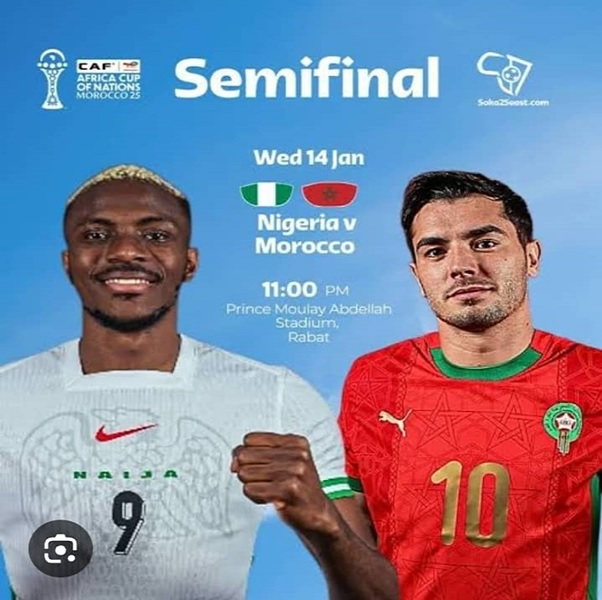
Nigeria faces Morocco in the 2025/26 Africa Cup of Nations (AFCON) today, 14th January 2026
It is D-Day. Nigeria faces Morocco in the 2025/26 Africa Cup of Nations (AFCON) today, 14th January 2026. Elegance meets endurance, method clashes with memory, and every pass, tackle, and strike will reverberate through decades of African football history. For Nigeria, AFCON is no abstract ambition—it is a recurring test of nerve, a battlefield they know intimately. Morocco arrive as architects of continental order, seeking to turn structure into conquest, while the Super Eagles carry a legacy of resilience, instinct, and hard-earned semi-final experience. This is more than a match; it is a collision of philosophies, where past precedent meets present promise.
This semi-final marks another return to terrain the Super Eagles know intimately. Nigeria are contesting roughly their sixteenth AFCON semi-final, an extraordinary measure of longevity in a competition designed to humble even the strongest favourites. Morocco, by contrast, reach the last four for approximately the sixth time—a sign of steady progress but also a reminder of the historical distance they continue to navigate. That numerical disparity speaks as much to philosophy as it does to history. Nigeria approach AFCON semi-finals not as rare opportunities, but as recurring responsibility. Morocco arrive with the burden of promise—the expectation that coherence, structure, and discipline must finally culminate in silverware.
What ultimately distinguishes Nigeria is not merely the accumulation of titles, but their deep comfort within AFCON’s emotional climate. The Super Eagles are rarely unsettled by hostility, unpredictability, or disorder. Hostile crowds, uneven pitches, officiating inconsistencies, and sudden swings in momentum are treated not as disruptions, but as conditions to be managed. AFCON consistently rewards teams capable of suffering without panic and improvising without losing structural discipline, and historically, Nigeria have mastered this delicate equilibrium. While global performances have fluctuated through cycles of transition and regeneration, their continental identity has remained strikingly intact. The Super Eagles do not require AFCON to bend to them; they adapt, recalibrate, and endure. AFCON speaks a language Nigeria have mastered through decades of exposure, reinvention, and belief.
Even in years without silverware, Nigeria have remained familiar occupants of the tournament’s decisive stages. Multiple runner-up finishes and an extraordinary number of third-place matches testify to a side that understands how to endure deep into competition. The Super Eagles have repeatedly rebuilt in transit—arriving with evolving squads yet retaining a collective memory of how the tournament must be approached. In the modern era, Nigeria’s AFCON journey has been defined less by unbroken dominance than by resilience and relevance. Transitional phases and early exits have alternated with deep, purposeful runs, including a third-place finish in 2019 and consistent progression into the knockout stages thereafter. Rarely crowned favourites, Nigeria have instead relied on tournament intelligence: knowing when to conserve energy, when to absorb pressure, and when to strike with finality. Setbacks, in Nigeria’s AFCON history, have seldom been allowed to calcify into eras.
Morocco offer a contrasting footballing proposition. They have been among the tournament’s most technically coherent sides—measured in possession, disciplined in shape, economical in execution. Their defensive structure has dictated tempo and limited exposure with impressive consistency. Yet AFCON history warns that control alone is insufficient at this stage. Order must be matched with ruthlessness, or it risks becoming decorative rather than decisive. Nigeria’s route has been more abrasive but no less effective. The Super Eagles have turned matches into tests of endurance rather than exhibitions of dominance. They have not dazzled consistently, but they have survived relentlessly. This is a team that understands when to retreat, when to disrupt rhythm, and when to deliver sudden clarity. As the tournament has deepened, Nigeria have grown more comfortable—a familiar AFCON pattern for a side that often announces itself late.
The contrast is philosophical as much as tactical. Morocco are more likely to control the ball, impose shape, and attempt to suffocate the contest. Nigeria are inclined to concede territory, invite pressure, and wait for the precise moment when structure cracks under stress. One team seeks to finish a long, careful sentence; the other relies on instinct and experience to deliver another familiar chapter. AFCON semi-finals have historically favoured emotional intelligence over aesthetic ambition, and Nigeria’s record—frequent appearances, repeated finals, ingrained belief—demonstrates mastery of this truth. Morocco’s history, though improving, has been more fragile, marked by excellence interrupted by hesitation at the brink.
Statistics sharpen rather than settle the argument. Nigeria enter with the tournament’s most assertive attacking numbers: fourteen goals scored—the most of any side—while conceding four and keeping two clean sheets through five consecutive victories. Their path included wins over Tanzania (2-1), Tunisia (3-2), Uganda (3-1), Mozambique (4-0), and Algeria (2-0), each reinforcing momentum rather than mere survival. Morocco, by contrast, have built their campaign on defensive authority: three clean sheets, one goal conceded, and nine goals scored, relying on economy rather than excess. Control is their currency; containment their confidence.
Nigeria will navigate this semi-final without their midfield anchor and captain, Wilfred Ndidi, suspended after yellow cards accrued in the knockout rounds. His absence removes a stabilising presence but opens space for Raphael Onyedika, whose energy, mobility, and range provide a different, urgent form of control. Morocco, buoyed by venue familiarity and continuity, will rely heavily on structure and positional discipline, but Nigeria are historically untroubled by atmosphere or geography. The Super Eagles fear no foe, shaped as they are by narrow escapes and unfinished business at the global level.
History between the two nations adds texture and drama. Nigeria and Morocco have met repeatedly over six decades, producing a rivalry marked by fluctuating dominance and defining moments. Most resonant is Rabat in 1983, when Nigeria held firm over two legs, prevailed on penalties, and qualified for the Africa Cup of Nations they would ultimately finish as runners-up. Notably, Nigeria have never lost a competitive match in Rabat—a quiet but enduring reinforcement. As the Super Eagles file onto the turf once more, memory accompanies them—not loudly, but steadily.
When the whistle blows, this is not just a contest for a place in the final. It is African football distilled: promise versus proof, patience versus punch, elegance versus edge. Morocco arrive trusting method; Nigeria arrive knowing AFCON rewards those who endure its storms. Today, one philosophy advances, the other returns to reflection—but for fans across Africa, this semi-final will be remembered long after the final whistle.
You can also read:
ELEGANCE WITHOUT CLOSURE: Morocco’s Long, Unfinished Affair with the Africa Cup of Nations
BUILT FOR THE STORM: Why the Africa Cup of Nations Feels Like Home to Nigeria