
AHMADU: Beyond Reasonable Doubt, A Formidable Organic National and International Newsmaker
- Published on September 15, 2026
- By U.S. Machika
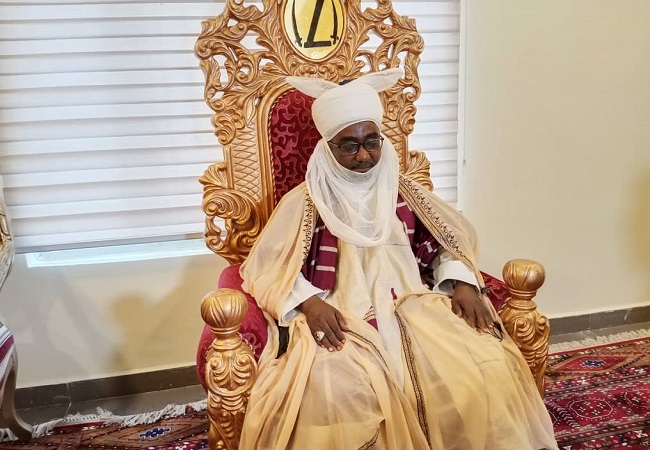
Ambassador Ahmed Nuhu Bamalli
His Highness, the 19th Emir of Zazzau
During the Media Trust Interview
From the turbulence surrounding his emergence to the present, virtually every significant public pronouncement Ambassador Ahmed Nuhu Bamalli, the 19th Emir of Zazzau, “Ahmadu”, has made has carried a double edge: it attracts both admiration and opposition, applause and scrutiny. Although Ahmadu does not habitually dabble in national discourse, particularly politics, his words are rarely allowed simply to pass. They are dissected, interrogated, challenged and, increasingly, harvested for secondary news.
The recently published Media Trust interview provides perhaps the clearest demonstration yet.
The original conversation was not casually edited and thrown into print. I have the complete recording, and the raw transcription runs to approximately eight pages of A4 in Times New Roman, 12-point type, without additional line spacing. The original conversation was painstakingly edited and published in three full pages, 9, 10 and 11, of Weekly Trust, Saturday 12th – Sunday 13th September, 2026 edition, accompanied by a more comprehensive Digital e-Copy, giving the conversation a fuller digital life beyond the print edition.
Indeed, taken together, His Highness was not merely interviewed; the interview was treated as an event. The original interview is already in the public domain, providing a readily verifiable record against which any subsequent attribution can be tested.
And that was only the beginning. Within an hour of the interview entering the wider digital ecosystem, His Highness demonstrated himself to be a formidable national and international newsmaker — a personality whose words possess sufficient weight and news value to generate stories far beyond their original context, across mainstream, independent, Hausa-language and social-media platforms.
The Emir’s responses were extracted by independent online platforms and social-media actors, translated, refurbished, recast, repackaged and rebranded as entirely new stories, some of which have travelled widely across the digital space. Some were faithful extracts. Others were selective, sensationalised or dramatically reframed. In some instances, headlines and captions appear to have gone beyond interpretation into deliberate provocation, misleading and distorted presentations and, in some cases, outright fabrications, seemingly less to inform than to score or settle particular scores with the Emir. And, in particularly striking instances, entirely new propositions appear to have been manufactured and presented as though they were the Emir’s own words.
One Hausa social-media platform, for example, carried the emphatic graphic assertion:
“Ya kamata a sake El-Rufa’i cikin GAGGAWA sannan a ba shi hakuri” - Bamalli.
— “El-Rufai should be released immediately and then apologised to.”
Yet His Highness never made that statement anywhere in the entire interview. What he actually said was that the public had not properly understood the role El-Rufai played in his return from Thailand to Nigeria. The distinction is not semantic. One is an explanation of a relationship and the circumstances surrounding his return to the country; the other is an entirely different and highly consequential fabrication.
That is not merely an extract. It is an outright manufactured proposition.
Another online platform is even more revealing. It carries the headline:
“El-Rufai Did Not Make Me Emir — I Paid $9,000 To Return To Nigeria With My Family” - Bamalli
The second part is genuine. His Highness did say that $9,000 was paid by the embassy for him and his family to return to Nigeria during the COVID-19 restrictions, and the published interview records him as saying that the receipts were available.
But the first assertion — “El-Rufai Did Not Make Me Emir” — was never uttered by the Emir in the interview. Criticism is one thing; manufacturing words and attributing them to the Emir is another.
Here again, a genuine statement has been joined to a proposition the Emir never made, and the composite has been presented as though both came directly from him.
This is where the distinction between extracting, interpreting, sensationalising and fabricating becomes important. Translation is not distortion. Editing is not manipulation. A provocative headline is not necessarily false. But when words that were never spoken are attributed to a public figure, the line has plainly been crossed.
In such cases, one wonders, whether the interview was actually read.
And the phenomenon has not been confined to English-language platforms. Hausa-language outlets have independently mined the interview for newsworthy fragments. One reported the Emir’s position on his relationship with El-Rufai and his emergence; another focused on the $9,000 return journey and the circumstances surrounding his arrival in Nigeria. Elsewhere, the personal revelation that his father left him and his siblings only N11,000 and five pieces of clothing was turned into a standalone story — itself a striking example of how one answer in a long interview can acquire an entirely separate news life.
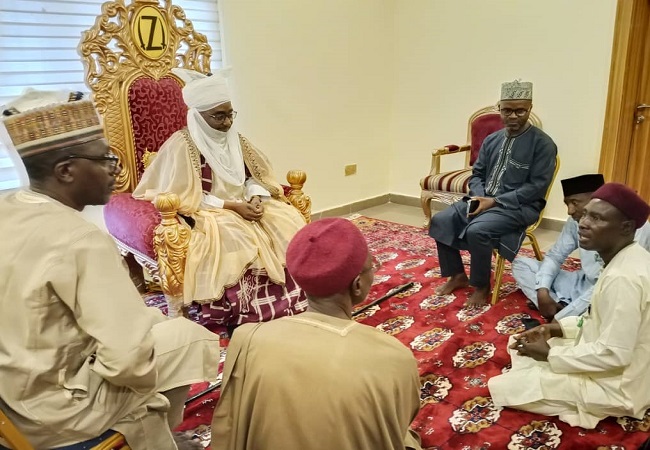
Hamza Idris
Editor-in-Chief Daily Trust — Seated Left
Conducting the Interview with the Emir of Zazzau
This proves beyond reasonable doubt that His Highness is a person whose words possess such extraordinary news value that other people and independent media platforms can take fragments of his utterances, recast them, translate them, repackage them and turn them into new news stories.
There has been commendation and criticism, agreement and disagreement, applause and condemnation. There is also a report that some people are contemplating a full-page rejoinder. Other voices have publicly challenged or condemned aspects of the interview.
The controversy eventually forced the Palace media team to issue a formal clarification in a press release, which I personally felt was unnecessary. Not every falsehood necessarily deserves the dignity of an official rebuttal. Sometimes silence, consistency and the steady publication of authentic information are more powerful than confrontation. A Palace should be careful not to allow mischievous or insignificant content to dictate its communications agenda. The issue is not whether the Palace has the right to correct the record; it is whether every falsehood is important enough to warrant being given an official platform.
In my view, if action was considered necessary, the more effective approach — without any public warning or threat — would be to take legal action against one or two persistent offenders. Action, as they say, speaks louder than words. A discreet but decisive response would arguably send a much stronger message than a public declaration of intent.
A consequential public figure cannot expect his words to produce universal agreement. When a leader speaks on matters of public importance, particularly from an exalted position as historically and institutionally significant as the Emir of Zazzau, his words will naturally attract scrutiny, interpretation and sometimes contention.
Had the interview passed largely unnoticed, eliciting neither serious commendation nor criticism, one might reasonably have wondered whether it had made an impact. But the present reaction tells a very different story.
The interview has travelled beyond the pages on which it was published and entered a much wider national conversation. It has made people talk about Zazzau, its history and contemporary relevance, the institution of traditional leadership and the responsibilities that accompany it.
That, to my mind, is the mark of a significant public voice.
Leadership is rarely exercised in an atmosphere of unanimity. Every leader will have admirers and detractors, those who applaud his convictions and those who question them. At the highest levels of public responsibility, criticism is not necessarily a measure of failure; sometimes, it is simply evidence that what has been said matters.
There is, of course, criticism that is useful and criticism that is merely partisan. There is disagreement born of genuine conviction and disagreement born of perception, misunderstanding or outright resentment. And there is a fundamental difference between legitimate criticism and the deliberate manufacture of statements a person never made.
The wisdom of leadership lies in being able to receive all of it with equanimity: to listen to criticism, extract whatever is useful, correct what needs correcting, ignore what deserves to be ignored, and remain faithful to the larger purpose. And I think that was what Ahmadu did.
And so, whatever one’s position on the individual issues raised in the interview, there is an inescapable conclusion.
Ahmadu is a formidable organic national and international newsmaker.
An organic newsmaker is someone who does not need to manufacture publicity; his position, personality, pronouncements and activities naturally generate news. In this case, Ahmadu’s words do not merely make news; they generate more news.
They are discussed, dissected, translated, extracted, interpreted, challenged, amplified, recast, repackaged and, sometimes, regrettably, reinvented or even fabricated.
That is a remarkable form of public influence.
He speaks, and news follows.
And perhaps that is the most compelling evidence of all that Ahmadu has become a consequential voice — not merely within the ancient walls of Zazzau, but in the wider national and international information space.