
AHMADU AT SIX: Every Legacy Has a Lifespan — Until It Is Written Into History
- Published on October 9, 2026
- By U.S. Machika
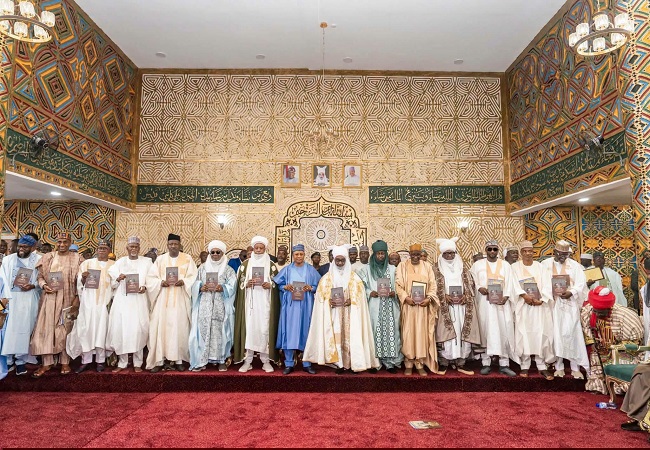
The Sultan of Sokoto, Alhaji Muhammad Sa’ad Abubakar III, and Kaduna State Governor, Senator Uba Sani, alongside the Emir of Zazzau, Ambassador Ahmed Nuhu Bamalli, CFR, flanked by other dignitaries, at the presentation of Emirs of Zazzau: A Biographical Study, 1808–2025, on 7 October 2026.
Wednesday, 7 October 2026, marks six years since Ambassador Ahmed Nuhu Bamalli, CFR, was appointed Emir of Zazzau. There is an intriguing symmetry to the occasion: he was appointed to the throne on a Wednesday; six years later, his anniversary falls again on a Wednesday; and, as if completing the circle, he himself was born on a Wednesday.
It is on this sixth anniversary, itself falling on a Wednesday, that the Emir of Zazzau presented the long-awaited book, “EMIRS OF ZAZZAU: A Biographical Study, 1808–2025,” to the public, commissioned four years ago by the Emir himself.
The convergence is striking: one Wednesday marks his birth, another his accession, and yet another now marks six years of his reign and the presentation of a work intended to preserve the Emirate’s history.
That distinction becomes more meaningful when the book is considered against what Ahmadu has done during his first six years on the throne. Under his stewardship, the Palace has been fundamentally reconfigured, with attention given to administration, welfare, documentation and institutional organisation. The Palace has also introduced more standardised administrative procedures, supported by a fully digitised public-service records system.
A Palace clinic now serves residents and neighbours, who have also been enrolled in the health insurance scheme. Where there was once no library, a standard Museum and Documentation Centre now stands. Previously uninhabitable residential quarters within the Palace have been transformed into modern living spaces. These are not merely cosmetic adjustments; they represent efforts to make the administration of an ancient institution more organised, the welfare of its people more humane, and the preservation of its institutional memory more systematic.
Perhaps one of the most significant features of Ambassador Ahmed Nuhu Bamalli’s six-year reign has been his humane approach to his subjects. He has deliberately and consistently cultivated a closeness with his people, reaching beyond the conventional boundaries of the throne to establish a more personal connection with the communities under his authority. Ahmadu has traversed the nooks and crannies of the Emirate, sharing in the grief of the bereaved and joining his people in their moments of joy. Places once considered too remote, or occasions once thought too modest, for a monarch’s presence have become part of his sphere of engagement. For the Emir, no community is too far, no occasion too small and no gathering too ordinary to provide an opportunity to meet his people, share in their experiences and affirm their place within the wider Zazzau family.
Yet, of all these achievements, the one the Emir regards as most endearing to him is not a building, a salary structure, a clinic or even an administrative reform. It is a book. That choice is revealing. A ruler surrounded by tangible evidence of change has chosen documentation as the achievement closest to his heart.
Perhaps the reason is simple: Every legacy has a lifespan. Monuments decay, institutions change, witnesses disappear and memories become less certain. A book possesses a different lifespan. It can carry an experience beyond the person who lived it and place it before someone born generations later.
Zazzau offers a powerful illustration in the legendary Malam Abdulkarim Juma’at Mosque. For approximately 187 years, it stood as an architectural and spiritual landmark. Generations worshipped within its walls; Emirs came and went; families inherited its memories and traditions. It was history standing in brick and mortar. Yet, after nearly two centuries, the structure collapsed. Its significance did not collapse with it, and its reconstruction will restore an important part of Zazzau’s physical heritage. But the original monument reached the end of its physical lifespan.
Memory is invaluable, but memory is also mortal. Some of the history documented in the new book has been preserved in newspapers, official documents, private papers, family archives and oral accounts. Much of it, however, has remained dispersed and, in some cases, dependent upon the memories of those who witnessed it.
The generation that remembers eventually becomes the generation that must itself be remembered. When witnesses disappear without adequate records, history becomes increasingly vulnerable to fragments, recollections and competing interpretations. An event may have happened, yet future generations may struggle to establish precisely what happened, why it happened, who was involved and how those who lived through it understood its significance. This is where the written word assumes its extraordinary power.
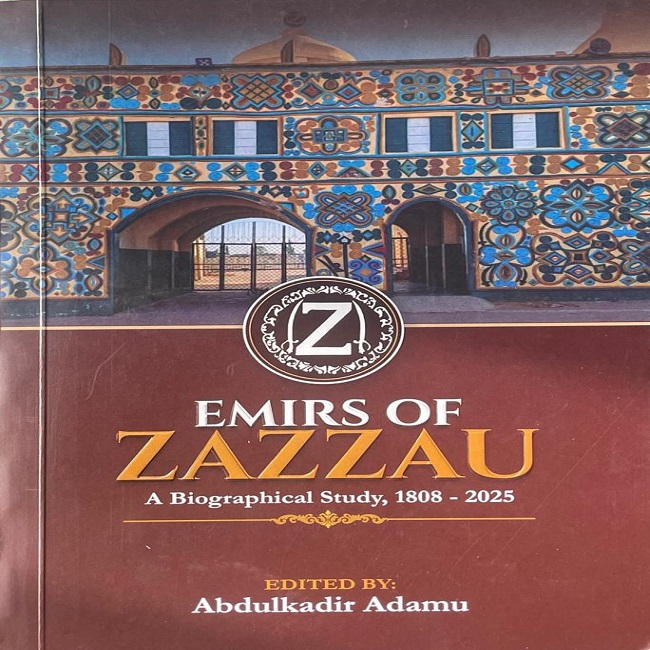
This is where the significance of the new history of Zazzau becomes clearer. Unveiled on 7 October 2026, the book reaches back to events dating from 1808, giving a documentary record to a past now 218 years distant. It does not merely preserve information about events more than two centuries ago; it gives them narrative presence, transforming distant occurrences into vivid mental pictures for later readers. Through the written word, the past becomes available to the imagination of the present.
The significance of that achievement becomes clearer beside M. G. Smith’s Government in Zazzau: 1800–1950, published in 1960. Smith’s study remains a foundational reference point for understanding Zazzau’s political and institutional history. It covered a 150-year period, yet in 2026 its earliest events are 226 years in the past and the book itself is 66 years old. Scholars may debate Smith’s interpretation, as scholarship should, but his work gave subsequent generations access to a past they had not witnessed. He did more than preserve information about events in 1800; he gave those events narrative presence, helping transform distant occurrences into vivid mental imagery in the minds of readers living more than two centuries later.
Importantly, history did not stop in 1950. Zazzau continued to live, change, struggle, adapt and produce new generations of rulers, institutions and experiences. Individual biographies have preserved aspects of particular reigns. Yet a biography of a ruler is not the same as a comprehensive history of an Emirate. The documentary gap between the Zazzau described by Smith and the Zazzau of the present has therefore remained.
There is a sobering lesson in what has happened to memory even within the very recent past. Ahmadu is only six years into his reign, yet already, parts of that recent history are beginning to recede into the imperfect chambers of memory. Some achievements are remembered vividly; others have become hazy; some may already have been forgotten; while others require recollection, institutional records and independent testimony to establish their place in history. If six years can begin to loosen the grip of memory on the details of a recent reign, what becomes of sixty years, a century, or two centuries without adequate documentation?
That question gives EMIRS OF ZAZZAU: A Biographical Study, 1808–2025 its deeper importance. Commissioned four years ago by Emir Ahmed Nuhu Bamalli, it is not merely another publication about Zazzau. Seventeen writers have contributed to the work, drawing from all four Fulani ruling houses of the Emirate. Their plurality matters, different experiences and interpretations can produce a richer documentary record, even without complete agreement.
Perhaps the most poignant evidence of the urgency of that undertaking is found within the book’s own history. Two of its contributors have since died. In a remarkable reversal, those who set out to document the history of Zazzau have themselves become part of the history they were documenting. They were not present at the unveiling, yet their contributions remain within its pages. There can hardly be a more powerful illustration of the difference between lived experience and recorded experience.
The person passes; the testimony remains. The voice falls silent; the words continue to speak. Future readers may encounter their thoughts; future scholars may cite them, challenge them or build upon them. Their own mortality has become an unintended demonstration of the proposition the book represents: people have lifespans, but what they commit to the written record can travel beyond them.
This is why the book should not be understood as an infallible or final account of the Emirate. There will inevitably be questions of interpretation, emphasis, sources and conclusions. Later scholars may disagree with some of its accounts, just as scholars have debated aspects of Smith’s interpretation. That is not a weakness; it is the normal life of serious history. A historical work does not remain alive because everyone agrees with it; it remains alive because every generation has something to say to it.
The Emir’s attachment to the book is instructive. In six years, he has altered things that can be seen and measured within the Palace. But he has also recognised that the most durable contribution a ruler can make is not necessarily the most visible one. A building may eventually require reconstruction. An administrative system may be replaced. A reform may be forgotten. Even a 45-year reign can begin to fade from living memory within six years of its conclusion. But when experience is carefully documented, it acquires another life—one that no longer depends entirely upon the lifespan of those who witnessed it.
Zazzau has therefore reached an important moment. The Emirate decided what of its past will remain available to the future. The new history is valuable not because it closes the book on Zazzau, but because it keeps the book open. It creates a foundation upon which another generation can write, question and add. It transforms memory into record, experience into evidence and the present into something posterity can examine.
Ambassador Ahmed Nuhu Bamalli may be six years into his reign, but the enduring question is what those six years will mean when the people who witnessed them are no longer available to explain them. That is when a reign ceases to be merely lived experience and begins to become history. Every human being has a lifespan. Every reign has a lifespan. Every monument has a lifespan. Every generation eventually becomes history.
But when a people take the trouble to document their journey, they give their experience another life.
Every legacy has a lifespan—until it is written into history.