WHY I’LL NOT CELEBRATE INDEPENDENCE ON 1ST OCTOBER 2026
- Published on October 1, 2026
- By ST. HEART CHIDOZIE OGU
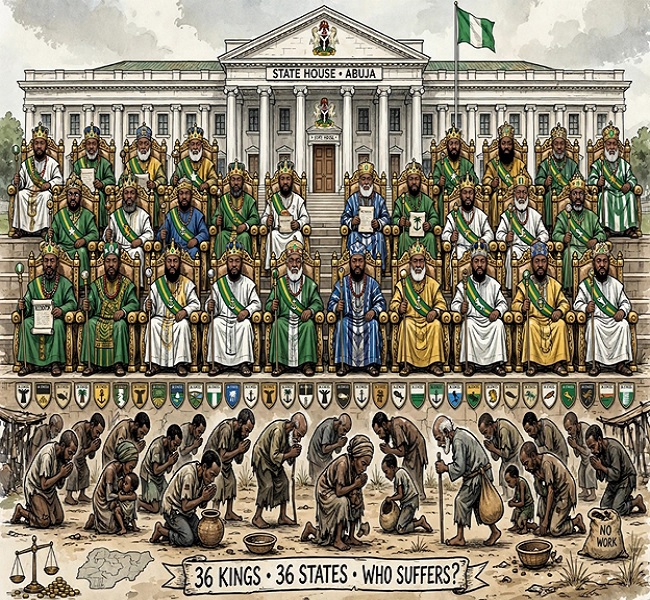
36 KINGS AND THE BURDEN PLACED ON NIGERIANS
On the 1st October 2026, Nigeria will be 66. The green-white-green will fly, speeches will be read, and the usual parade of power will take place in Abuja. But I, St. Heart Chidozie Ogu, will not be celebrating. There will be nothing to celebrate.
Independence was supposed to mean freedom. Freedom from oppression, freedom from want, freedom to build a nation where merit matters and life has value. Sixty-six years after, we have replaced the colonial master with a more ruthless master: our own. Therefore, I shall be decorated with black attire.
- BAD LEADERSHIP AS A CULTURE
We do not have a leadership crisis; we have a culture of bad leadership. A leadership that sees public office not as service but as investment to be recouped with profit. In 2026, our leaders still govern by press releases and photo opportunities while the nation rots from within. They have no plan, no empathy, and no shame. How do you celebrate independence when those leading you are still dependent on foreign hospitals, foreign schools, and foreign ideas to survive?
- INSECURITY: A NATION HELD HOSTAGE BY ITS OWN
What independence exist when you cannot travel from Abuja to Kaduna without writing your will? When farmers cannot go to farms in Benue, Zamfara and Plateau? When our children are kidnapped from their classrooms and become business transactions running into millions if not billions? Banditry, terrorism, kidnapping, cultism and ritual killings have become our daily news. The government that should protect us has outsourced our security to prayers and press statements. We are independent on paper, but prisoners in our own land.
- CORRUPTION AND FAKE GOVERNMENT AGENCIES
Corruption is no longer hidden; it is official. It wears agbada, suit and uniform. Billions disappear in ministries, yet no one is jailed. And worse, we now live under the tyranny of fake government agencies, both real agencies acting fakely and fake actors acting like agencies. Agencies that exist only to extort, not to serve. One checkpoint to the next, one levy to the next, one duplicated office to the next. From revenue touts in uniform to regulatory bodies that regulate nothing but their pockets, the Nigerian citizen is bled daily by the very institutions created to protect him. Like what happened in Minna, Niger State following the unfortunate deaths of some persons arrested by the National Security and Civil Defense Corps (NSCDC) in connection with suspected illegal mining in the state.
- POVERTY, INFLATION AND A DYING ECONOMY
They tell us the economy is growing, but whose economy? In the market, a bag of rice is now beyond a minimum wage. Inflation has eaten up salaries before they are paid. Poverty is no longer in the village alone, it is in the cities, in suits, among graduates who ride okada to survive. We are a nation rich in Oil, Gas, Minerals, Gold, and brains, yet poor in everything that matters. How do you celebrate independence when independence has not translated to food on the table?
- NEPOTISM: THE DEATH OF MERIT
The final nail is nepotism. Federal character has been replaced by family character. Appointments, promotions, admissions, and even justice are now distributed based on tribe, religion, and personal loyalty to those in power. A qualified Nigerian youth is told to bring a godfather before he can get a job his certificate already qualified him for. When merit dies, a nation dies.
So on October 1st 2026, I will not wear green-white-green. I will not shout Happy Independence. I will sit, mourn, and reflect on black attire for this is indeed “Independence Slavery”.
I love Nigeria. That is why I cannot pretend. True patriotism is not in celebrating a flag while the country behind the flag bleeds. True patriotism is telling the truth that we are not yet independent. We have political independence, but we do not have economic independence, security independence, or freedom from corruption.
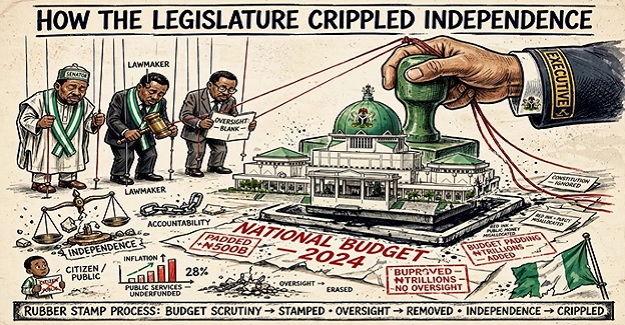
HOW THE LEGISLATURE CRIPPLED OUR COMMONWEALTH
THE GOVERNORS FACTOR: 36 KINGS AND THE BURDEN THEY PLACE ON US ALL
If Abuja is blamed for our national failure, the 36 Government Houses must share the larger part of the blame. We talk about the Presidency while our Governors act as emperors who have privatized our states and pauperized our people.
The poverty and hardship ravaging Nigeria today is not only made in Aso Rock. It is manufactured daily in our state capitals.
- HOW THEY MANUFACTURE POVERTY AND HARDSHIP
- The FAAC Sharing Mentality: Most governors have killed the idea of governance. They do not build economies, they wait for monthly FAAC allocation from Abuja like school children waiting for pocket money. When the money comes, it is spent on frivolities, convoys, and political patronage. Internal generated Revenue is used as personal revenue.
- Local Government Loot: This is the greatest fraud in Nigeria. Governors have effectively killed local governments. They collect local government funds through the Joint Account, conduct sham elections where their party wins 100% or at worst 85%, and appoint caretakers who answer only to them. The result? No rural roads, no primary health centers, no primary schools. Poverty is forced to stay in the village, and the village man is forced to run to the city to become poorer.
- White Elephant Projects Over People: A governor will owe teachers and doctors 6 to 12 months’ salary, will owe pensioners who built the state, but will be commissioning a flyover that leads to nowhere, an airport where no plane lands, or a stadium in a state where children learn under trees. They build projects that inflate contracts, not projects that lift people.
- Weaponizing Hunger: Empowerment in many states has been reduced to sharing 5, 000 naira, cups of rice and a wrapper during elections. They keep the youth poor, unemployed and dependent, so that during elections they can be bought for a token and used as thugs.
- How They Fuel Religious Bias and Division
This is perhaps their dangerous contribution.
Governors were elected to be governors for all – Christians, Muslims, traditionalists, and none. But many have become religious champions instead of state leaders.
They do it in three ways:
- Biased Appointments and Patronage: In some states, if you are from the wrong religion or denomination, you cannot get a commissioner position, a board appointment, a scholarship, or even employment as a cleaner in Government House. Merit is replaced with “he is our brother / sister in faith”. This tells the citizen that his state does not belong to him / her.
- Sponsoring Division for Politics: When it is convenient, they play the religious card. They fund religious groups loyal to them, give land and money to one faith while demolishing or denying the other. They turn a simple farmers-herders clash or a chieftaincy tussle into a religious war to distract from their failure.
- Silence in Injustice: When violence happens against a minority faith in their state, they go silent, or they issue a weak statement, because condemning it will cost them votes from the majority. That silence is approval. That approval breeds the next crisis.
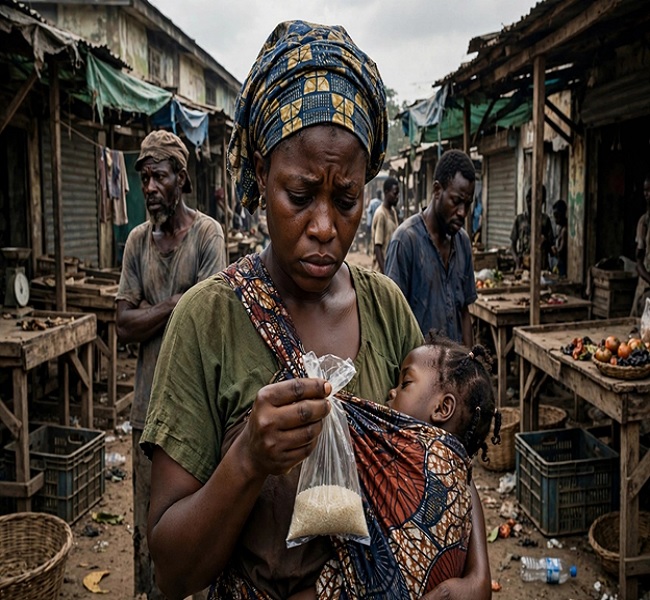
A NATION HELD HOSTAGE
A governor who shares appointments based on faith, who demolishes a church or mosque for political reasons, who cannot condemn the killing of his own citizens because of religion, has failed the oath of office.
Nigeria cannot be fixed by fixing only the President. The Federal Government is far, the state government is near. The road to your house, the school your child attends, the hospital that should save your mother, father, children, the security in your street, all of these are primarily the duty of the governor.
Until we start holding governors accountable with the same energy we hold the President, until we demand open local government accounts, budget transparency, and an end to using religion as a tool of oppression, our independence will remain meaningless.
The hardship in Nigeria has 36 branches, and they all sit in Government Houses across the federation.
HOW THE LEGISLATURE CRIPPLED OUR INDEPENDENCE?
If the Executive is the hand that steals our independence and the Judiciary is the eye that looks away, then the Legislature is the leg that carries the stolen goods. The arm of government that should be the voice of the people has become the whisper of the executive.
We were told that the legislature is the symbol of democracy. That while the military had everything, it did not have a National Assembly. Today we have a National Assembly, but we do not have democracy. We have a gathering of dealmakers who have dwarfed our independence.
This is how they did it:
- From Lawmakers to Lawbreakers and Budget Padders
The primary duty of the legislature is to make laws for good governance. Our legislators have turned lawmaking into private business.
Every year, the budget that is presented as a plan for the people is padded, inflated, and butchered to insert billions for projects that will never be executed. The budget is no longer a national document, it is a sharing formula. They allocate boreholes for 50 million naira that costs 1 million, streetlights that never light, and training programs that never train anyone.
They call it “Constituency projects” but it is constituency fraud. Money is released, no work is done, and oversight dies in the same House that approved it.
- The Rubber Stamp Doctrine
A vibrant legislature checks the excesses of the executive. Our legislature competes to please the executive.
At the National Assembly and in all 36 States, legislative independence has been sold. In the States, the House of Assembly is now an extension of Government House. The Governor decides who become Speaker, who becomes what, and what bill must be passed. A State Assembly that should question why local government funds are stolen, why pensions are not paid, why insecurity is rising, instead passes a vote of confidence on the Governor every Tuesday morning.
At the federal level, they have perfected the slogan: “We will do what the President wants”. When a legislature says that, the people have lost. Checks and balances die. Independence dies.
- Oversight for Sale
The constitution gives the legislature the power of oversight – to summon, to investigate, to expose corruption. Today, oversight has become oversite for sight-seeing and extortion.
MDAs are invited not to account, but to settle. A hearing is announced on television, noise is made, envelopes are exchanged behind closed doors, and the matter dies. The probe into missing oil money, into failed power projects, into Customs and NNPCL, all end without consequence. The legislator who should expose corruption uses it to feed.
This is why no one fears the legislature anymore. Agencies no longer respect invitations because they know it is business as usual.
- Laws for the Powerful, Not for the People
When did our legislature last make a law that truly lifted the poor? But they are quick to pass laws that increase their own salaries and allowances, laws that give them immunity, pensions for life, exotic cars every year, and billions for renovation of chambers that already look like palaces.
And laws for minimum wage enforcement, for compulsory free basic education, for protection of tenants, for justice for victims of police brutality, for regulation of fake agencies that extort Nigerians daily gather dust in committees for years.
They make laws that protect the government from the people, not laws that protect the people from the government.
- Representation Without Presence
A legislator is supposed to live among his people. Ours live in Abuja and visit during elections. They have no constituency office, no town hall, no report card. They appear only when it is time to share rice and wrappers.
The people do not know their Senator, their House of Reps member, their State Assembly member. And the member does not know the people. That disconnect is why laws made do not reflect our hunger, our insecurity, and our daily struggle with inflation and nepotism.
Nigeria is running on one leg because the legislative leg is broken. We cannot celebrate independence when those who should speak for us have been silenced by allowances. When those who should approve for the people only approve for themselves.
An independent Nigeria needs an independent legislature. One that can say no to the President, no to the Governor, and yes to the people.
Until our National Assembly and State Assemblies stop being retirement homes for failed governors and stop being rubber stamps that only stamp what will benefit them, our independence will remain dwarfed – short, stunted, and unable to grow.
HOW THE JUDICIARY FAILED AND GAVE COVER TO THE ABUSE OF NIGERIA’S INDEPENDENCE
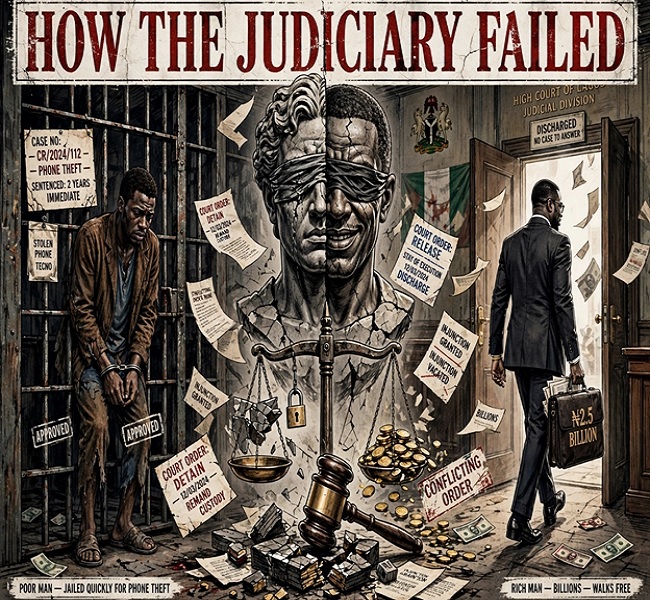
HOW THE LEGISLATURE CRIPPLED OUR COMMONWEALTH
In every democracy, the Judiciary is the last hope of the common man. In Nigeria today, that hope has become hopeless. We did not just lose our independence to bad executive leaders and emperor-governors, we lost it because the institution that should have stopped them sold its gavel.
The abuse of our independence is not possible without the failure of the Judiciary.
- From Justice to Technicalities
The Nigerian judiciary has perfected the art of delivering judgements without delivering justice. Cases are decided not on merit, not on truth, but on technicalities, on who has the better Senior Advocate, and on who knows the judge.
A poor man who steals a phone gets 3 years in prison within 48 hours. A public officer who steals 3 billion naira gets an order of perpetual injunction restraining any agency from ever investigating him. The law has two faces in Nigeria: one harsh and swift for the poor, one soft and slow for the rich. When citizens see this, they lose faith in independence itself.
- The Market of Conflicting Orders and Ex-Parte Black Market
How did we get here?
We now live in a country where a judge in one state can give an order removing a national chairman of a party, and another judge in another state restores him the next day. Where a court can stop INEC from conducting an election or stop a House of Assembly from performing its duties, all through midnight ex-parte orders.
This “forum shopping” has turned our courts into a supermarket where politicians go to buy the judgement they want. When the judiciary allows itself to be used to truncate democracy, to stop impeachment of a failing governor, or to protect a corrupt official from probe, it is no longer an arbiter, it is an accomplice.
- The Slow Death of Justice: Adjournment as Punishment
Justice delayed is justice denied. In Nigeria, justice is not delayed, it is killed. A corruption case lasts 5 to 10 years. The accused uses the court to secure endless adjournments, goes on medical trips abroad, and returns to be celebrated. Witnesses die, judges are transferred, files disappear. At the end, we are told the case has no merit because prosecution could not prove its case.
Meanwhile, the man who looted money meant for hospitals and schools walks free to contest again, now richer and more powerful. This failure has taught public officers that you can steal and get away with it if you can afford to drag the case.
- Election Judiciary, Not Election Democracy
The most painful failure is in elections. The people vote, but the courts decide. Our elections are now won in the courtroom, not at the polling unit.
When the judiciary delivers questionable judgements that contradict the clear will of the people, when tribunal judgements are seen as negotiated and not adjudicated, the citizen concludes that his vote does not count. And when a man’s vote does not count, he is not independent. He is a subject.
- The Failure to Defend Fundamental Rights
Under military rule, the judiciary was more courageous. Today, under civil rule, it trembles. When security agencies disobey court orders and nothing happens, when a citizen is detained despite bail granted by a court, and the judge cannot enforce his own order, the judiciary has been reduced to a toothless bulldog.
An independence where a court order can be ignored by the executive, where DSS, Police and EFCC act above the law, is not independence. It is tyranny.
No Independence Without an Independence Judiciary
We cannot celebrate independence when the Judiciary itself is not independent.
The chain is clear. Bad leadership steals. Governors oppress. But it is the failure of the Judiciary to punish the thief, to check the governor, and to protect the poor that allows the abuse to continue from one October 1st to another.
To save Nigeria, we must save the Judiciary from itself. We need
- Real financial and administrative autonomy for the judiciary, so a governor cannot punish a Chief Judge by withholding funds.
- A transparent system of appointment and discipline of judges, where corrupt judges are not retired but dismissed and prosecuted.
- Time limits for corruption and election cases.
Until a poor man can walk into a Nigerian court and get the same justice as a rich politician, until a court order means the same thing in Yenagoa as in Abuja, we have not yet gained independence.
We only replaced the white wig of the colonial judge with a black wig that bows to power.
Until we free ourselves from bad leadership, until a Nigerian life is safe and valuable, until our institutions serve the people and not prey on them, until hard work can feed a family and merit can lift a man without knowing someone in power, there is nothing to celebrate.
The Executive may have abused our independence, the Judiciary may have failed to defend it, but the Legislature auctioned it.
St. Heart Chidozie Ogu writes from Zaria Kaduna State
Barwan Sabon Gari
