
ABUBAKAR MALAMI'S FORFEITURE: Punishment or Absolution? – IV
- Published on July 30, 2026
- By U.S. MachikaU.S. Machika
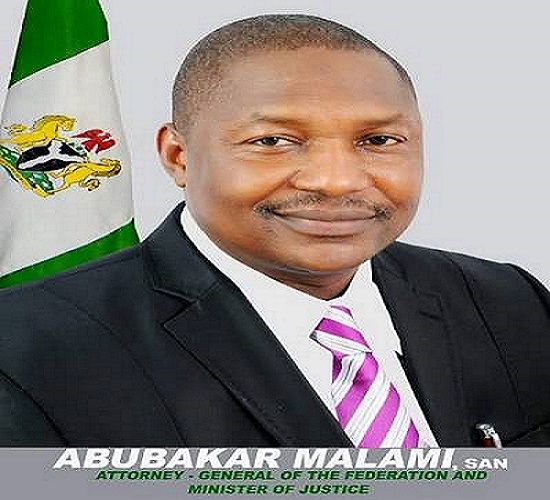
Abubakar Chika Malami, SAN
Nigeria's former Attorney-General of the Federation and Minister of Justice
— Continued from —
ABUBAKAR MALAMI'S FORFEITURE: Punishment or Absolution? – I
ABUBAKAR MALAMI'S FORFEITURE: Punishment or Absolution? – II
ABUBAKAR MALAMI'S FORFEITURE: Punishment or Absolution? – III
Beyond Forfeiture: Justice, Governance and Nation-Building
The previous discussions in this series have examined the moral destination of punishment, the distinction between accountability and perpetual stigma, and the proposition that if judicial scrutiny is just for one politically exposed person, it ought to become the standard for all. Yet another dimension of the Malami controversy still remains.
It is a dimension that has received comparatively little public attention, not because it lacks importance, but because it only emerges after the court has completed its work. It is no longer primarily a legal question, nor is it exclusively a political one. It is a question of governance, economic stewardship and nation-building.
Once justice has recovered property, what exactly has the nation recovered, and what responsibility does the nation assume thereafter? Every forfeiture order determines one legal issue: ownership. Who should lawfully own the disputed property? The court is concerned with whether particular assets should remain in private hands or vest in the State. Once that determination has been made, however, another responsibility begins. Law determines ownership. Governance determines usefulness. Economics examines consequences.
The court may recover an asset, but only prudent public administration can ensure that the asset continues to serve the public interest. These are different responsibilities, yet they are inseparable. Justice without sound governance risks becoming a victory whose long-term benefits are never fully realised.
Assuming, solely for the purpose of discussion, that the forfeiture ordered by the trial court ultimately survives the entire appellate process, one feature of this controversy deserves careful attention. The assets reportedly affected are, by and large, situated within Nigeria. They are not anonymous deposits concealed behind layers of offshore secrecy, nor are they luxury residences beyond the reach of Nigerian institutions. They include landed property, commercial investments and educational facilities located in Birnin Kebbi, Kano and Abuja. Whatever legal questions may surround their acquisition, they remain physically rooted within the Nigerian economy.
That distinction is economically significant. Unlike financial assets transferred abroad, productive investments continue to generate economic activity where they exist. A university continues to educate students. A hotel continues to receive guests. Commercial premises continue to provide services. Employees continue to earn their livelihoods. Local suppliers continue to transact business. Transport operators, artisans, food vendors and countless other participants within the local economy continue to derive income from enterprises that remain operational. Such investments become part of the economic life of the communities in which they are established.
This reality assumes even greater importance in states where the private sector remains comparatively small and government continues to dominate economic activity. Kebbi State illustrates this challenge. Although richly endowed with agricultural potential and mineral deposits, it continues to seek broader industrialisation, greater private investment and expanded educational opportunities. In such an environment, every major productive enterprise carries significance extending far beyond its immediate owner because it creates employment, stimulates commerce and contributes to the gradual diversification of the state's economy. Questions surrounding ownership therefore coexist with questions concerning the continued productive value of those investments.
None of these observations should be misunderstood as diminishing the importance of accountability. If assets have been unlawfully acquired, the law must take its proper course without fear or favour. The economic usefulness of an asset cannot convert an unlawful acquisition into a lawful one. Law and economics simply examine the same asset from different perspectives. The law asks whether ownership was lawfully obtained. Economics asks what value the asset contributes to society. One discipline does not cancel the other. Rather, each completes the understanding of the other.
Nigeria's experience over several decades also presents another important lesson. Allegations have frequently arisen that public wealth was not merely misappropriated but expatriated through foreign bank accounts, offshore companies and investments established beyond Nigeria's borders. Whenever that occurs, the nation suffers twice. It suffers first through the alleged loss of public resources and again because those same resources cease to generate employment, enterprise, taxation and economic activity within the communities from which they were allegedly derived. Capital flight therefore represents not merely a financial loss but also a developmental loss.
It is against that background that another question quietly emerges. If visible productive investments are inherently easier to identify, investigate and, where the law so requires, forfeit than wealth concealed through complex financial arrangements or transferred abroad, has the prospect of future scrutiny unintentionally influenced the form in which questionable wealth is preserved? The answer cannot be asserted with certainty, and this essay makes no such claim. Yet the possibility itself deserves reflection because it highlights one of the unintended economic consequences of corruption. Wealth hidden from scrutiny seldom creates the same opportunities for employment, enterprise and local development as wealth invested productively within the domestic economy.
If this discussion has so far considered the recovery of assets, it must now confront an even more demanding question. Recovering productive property is one achievement; sustaining its productivity is another altogether. The court may determine ownership, but it cannot determine management. Once assets pass into public ownership, by what institutional arrangements should they be administered so that they continue to educate students, employ workers, provide services and contribute to national development? Justice may recover an enterprise, but only good governance can preserve its economic value.
That question is necessary, because, Nigeria's own economic history demonstrates that governments have, over the years, embraced privatisation and commercialisation largely because the State has not always proved to be the most efficient manager of commercial enterprises. Numerous publicly owned hotels, industries and businesses gradually declined through neglect, weak maintenance, political interference or corruption before many were eventually privatised.
That historical experience inevitably raises another legitimate question. If productive assets are recovered through forfeiture, what institutional safeguards will ensure that they do not become casualties of a different cycle of inefficiency, neglect or corruption?
This is not an argument against public ownership. Neither is it an endorsement of privatisation in every circumstance. It is, however, an argument for thoughtful governance. The objective of forfeiture should not simply be a transfer of ownership from one legal entity to another. It should be the preservation and enhancement of public value. Whether that objective is achieved through direct public administration or, where appropriate, through transparent and properly regulated institutional arrangements, including carefully supervised Public-Private Partnerships, is ultimately a matter of public policy.
Whatever model is adopted, the guiding principle should remain constant: recovered assets must continue to serve the public interest with transparency, efficiency and accountability.
Perhaps the most enduring lesson of this controversy therefore extends far beyond the fortunes of any individual. Justice should aspire to accomplish two recoveries. The first is legal. It restores to the nation property which the courts determine ought not to remain in private hands. The second is economic. It preserves productive assets already embedded within the Nigerian economy so that they continue to generate employment, enterprise, education and opportunity for the benefit of present and future generations.
Justice, if accepted as lawfully administered, recovered more than title deeds. It recovered productive assets already anchored in Nigerian soil. The law changed their ownership; it did not uproot their economic footprint.
Perhaps, therefore, the true legacy of the Malami controversy will not ultimately be measured by one court case, one forfeiture order or one political figure. It will be measured by whether Nigeria chooses to recover something far greater than disputed property. The nation has an opportunity to recover confidence in the rule of law, confidence in impartial accountability, confidence in productive enterprise and, above all, confidence in the enduring principle that public office exists as a sacred trust for the common good rather than as a pathway to private accumulation.
Justice reaches its highest purpose not merely when it recovers property, but when it helps recover the confidence, the conscience and the future of a nation.
— The End —