
ELASKA–AYOOLA: A Daughter’s Wedding Revealed a Father’s Life Better Than Any Biography Could
- Published on August 20, 2026
- By U.S. Machika
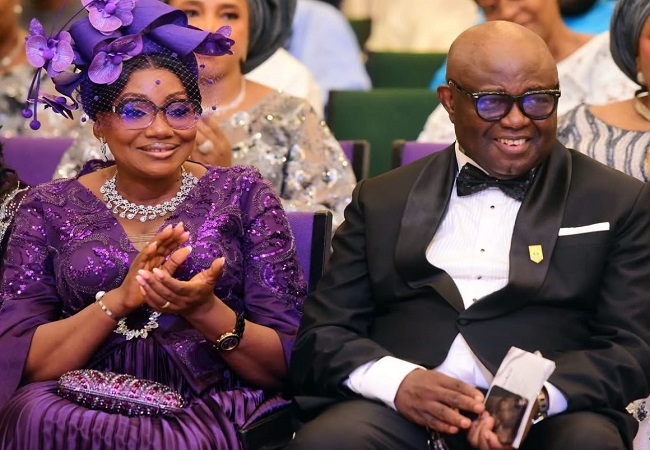
Major General Timothy Anlaini Chinoko (Rtd.) and Mrs Maimuna Joy Chinoko
At the wedding reception of their daughter, Miss Jemimah Silaelaska Chinoko, and Mr Ayoola Abolade
A daughter’s wedding can reveal a father’s life in ways no biography can. A biography tells us where a man went, the positions he occupied, the responsibilities he carried and the achievements that followed him through his career. A wedding can tell us something more intimate: who remembers him.
Before the first hymn was sung and the first verse recited during the wedding solemnisation, it was already becoming clear that Elaska and Ayoola’s wedding had brought together more than two families. It had brought together the different chapters of a man’s life.
Around the young couple stood people who had known Major General Timothy Anlaini Chinoko (Rtd.) at remarkably different stages of his journey. Some had shared classrooms with him; others had shared commands, responsibilities, professional challenges and years of service. They had not come together for a military reunion, a professional conference or a ceremonial citation. They had come because his daughter was getting married.
And that was when the wedding began to tell another story — the story of the bride’s father, Major General Timothy Anlaini Chinoko (Rtd.), the story of a lifetime of service, measured not by the offices a man once occupied, but by the people who still remember him.
For all the distinguished people who gathered around General Chinoko, however, perhaps the most revealing testimony to the man behind the uniform was standing beside him on the dance floor. The father-and-daughter dance was more than a charming ritual of the reception; it was a glimpse into a relationship that years of military discipline, command and public responsibility had not hardened.
Here was a General, accustomed to the language of command and the discipline of hierarchy, moving with his daughter in an unmistakable display of affection, tenderness and pride. The military may have taught him how to command men, but the moment suggested that fatherhood had taught him something different — how to love without command. Elaska was not merely a daughter being celebrated by her father; she was a daughter being cherished by him.
There was an ease between them that made the moment feel less ceremonial than intimate. Whatever the demands of a military family — discipline, expectations, standards and responsibility — they had not imprisoned the relationship between father and daughter. Elaska could stand beside her father with the freedom, confidence and affection of a daughter who had been guided without being emotionally caged.

Elaska and Ayoola
The Beginning of a Shared Journey; Two Lives, One Journey
A man’s career can tell us how he served his country; the way he loves his daughter can tell us how he served his family.
That moment also made the presence of two other people particularly significant: Mrs Maimuna Joy Chinoko, General Chinoko’s wife, and his father, Captain Daniel Gauza Chinoko (Rtd.), himself a nonagenarian and family patriarch. Their presence connected the public story of the General to the private life from which that story emerged.
Before General Chinoko became the officer whose career would create so many enduring relationships, he was first a son. Before he became the father celebrating his daughter’s marriage, he was a husband and family man. His father represented the generation from which he came; his wife, the companion with whom he built his family; and Elaska, the daughter whose wedding had unwittingly opened to the public so many chapters of her father’s life.
There was something almost poetic about that generational continuum. A nonagenarian father watched his son celebrate his daughter. A husband stood beside the woman with whom he had built his household. A father watched the daughter he had raised begin a household of her own. Past, present and future had quietly occupied the same celebration.
From that private architecture, the wider story of General Chinoko’s life began to emerge.
The support surrounding the wedding extended into the spiritual community where he has served. As a Pastor and District Secretary of Foursquare Gospel Church, Asokoro, he enjoyed the support and goodwill of the Church leadership. Rev. Babajide Olowodola, the Founding Pastor; Rev. Julius Msheliza, the District Overseer; Pastor Tope Kayode-Ojo and others rallied around the family. Their presence demonstrated that General Chinoko’s relationships were not confined to the military establishment. There was also a spiritual community within which he had served, worshipped and built enduring relationships.
From his native constituency came another expression of solidarity. Distinguished Senator Garba Musa Maidoki was personally present at both the Church wedding and the reception, bringing into the celebration the political and community constituency associated with the bride’s family.
Then came Justice Danlami Zama Senchi, (Wazirin Zuru), a respected Justice of the Court of Appeal, who chaired the reception. His role appeared to extend beyond the formal responsibility of presiding over the programme. He carried himself almost as a royal and fatherly figure around General Chinoko throughout the occasion, while his presence also brought significant representation from the Bench and Bar. Among those present was Justice Sharon Tanko, accompanied by her husband, Professor Ishaya Tanko, Vice-Chancellor of the University of Jos. M.D. Sulaiman, a retired Director of the Central Bank of Nigeria, was also among the distinguished personalities who came to identify with the family.
Yet, impressive as these different constituencies were, they were only beginning to reveal the extent of the relationships surrounding the General.
The military was where the story became particularly compelling.
General Chinoko did not merely spend a career in the military; he passed through a succession of institutions, courses, commands and professional associations that helped shape both the officer and the relationships he carried with him long after particular appointments had ended. In a sense, the General had lived four extraordinary military lives: the Nigerian Military School, Class of 1975; the Nigerian Defence Academy 29 Regular Course; the fraternity of officers commissioned in 1989 through Club ’89; and the intellectual and strategic fraternity of the Nigerian Institute of Policy and Strategic Studies, Kuru.
Each of these chapters seemed to remember him.
His military journey began at the Nigerian Military School, and members of his NMS Class of 1975 turned out in colourful numbers to celebrate with him and his family. Beyond his immediate course mates, the National President of the Ex-Boys Association, Mr Muhammad Baba Marte, and members of his executive were present in their distinctive regalia. It was a visual reminder that relationships forged in the formative years of military education can survive for decades, long after the boys have become officers, commanders, strategists and, eventually, retired soldiers.
His Nigerian Defence Academy 29 Regular Course colleagues were equally represented. Commodore Teidi (Rtd.), President of the 29 Regular Course Association, was among those who came to identify with the General and his family. Members of Club ’89, the fraternity of officers commissioned in 1989, also rallied around him, while his association with NIPSS, Kuru, brought yet another circle of professional and intellectual colleagues into the gathering.
Comrades from the various military courses and appointments through which his distinguished career had taken him also came to identify with the family. Collectively, they appeared almost to provide the General with a ceremonial “covering fire” — not for battle, but for a profoundly different campaign: the celebration of his daughter’s marriage.
The magnitude of that military presence was underscored by the attendance of two former Chiefs of Army Staff, Lieutenant General Tukur Yusuf Buratai and Lieutenant General Faruk Yahaya. The serving Chief of Army Staff was also represented by Major General Ejike. Numerous serving and retired officers were conspicuously present, including Major General Biu, Major General R.O. Yusuf, Air Vice Marshal Sallau Ribah, General Bande, Rear Admiral J.K.Z. Ango, Rear Admiral T.Y. Pani and Air Vice Marshal Lucky Danbaki, among other serving and retired officers.
The wedding did not create General Chinoko’s influence; it revealed it.
The significance of such a gathering went beyond the number of uniforms in the room. Officers who had occupied different ranks, served in different formations and travelled through different stages of their careers had converged around one family. Rank may establish hierarchy during service, but the esprit de corps forged through shared experience can survive the hierarchy. The reception offered a rare opportunity to see that otherwise invisible network made visible.
There was, however, something even more admirable about the whole display:
The military fraternity did not overwhelm the wedding.
That distinction matters. An influential parent with a powerful institutional network can easily, even without intending to, cast a long shadow over a family ceremony. The gathering can become so dominated by the stature of the parent that the young couple gradually become spectators at their own celebration. That did not happen at the Elaska–Ayoola wedding. The military presence was substantial, but it remained complementary. The officers came because of General Chinoko, but they were there ultimately to celebrate his family and, above all, the young couple.
The General’s influence did not produce dominance; it produced value. His military fraternity surrounded Elaska and Ayoola with honour, solidarity and affection. His Church community brought spiritual fellowship. His Zuru constituency brought another expression of community identity. The Bench and Bar, academia, politics and other professional circles added their own strands. Each represented a different chapter of one man’s life converging around one family occasion.
Seen from that perspective, the wedding became almost a living map of General Chinoko’s journey. The NMS Class of 1975 represented the beginning; NDA Course 29, professional formation; Club ’89, another generation of commissioned service; NIPSS, intellectual and strategic development; the Church, faith and service; the Bench and Bar, professional relationships; and the Zuru constituency, community and belonging. Around all these strands stood the family itself, which provided the reason for their convergence.
This, perhaps, is the more enduring meaning of a lifetime of service. Public service is often measured through appointments, promotions, commands, achievements and official records. Yet there is another measure that cannot easily be entered into a résumé: the people whose lives one has touched deeply enough for them to remember, return and stand beside one’s family decades later.
A wedding such as this can reveal a person’s social capital in a way no formal biography can. It tells us who remembers him, who feels connected to him, who considers his family’s happiness worth sharing and who is prepared to suspend the demands of their own busy lives to be present when it matters. That is a different kind of wealth. It cannot be purchased at a reception or conferred by an appointment. It is accumulated slowly through service, friendship, professional association, shared experiences, loyalty and the countless human encounters that form the invisible architecture of a lifetime.
Perhaps this is why the distinguished career of the bride’s father did not diminish the moment belonging to Elaska and Ayoola. On the contrary, it added another layer of meaning to their celebration. Those who gathered around General Chinoko were, in a sense, also celebrating the relationships, friendships and experiences that had helped shape the family into which Elaska was born.
And yet, for all the attention that naturally followed the General and the impressive network surrounding him, it remained Elaska and Ayoola’s day. The military officers, senior lawyers, academics, political figures, Church leaders, relatives and friends were there because a family occasion had brought two young people together. Their prominence did not compete with the couple; it created an atmosphere in which the couple could be celebrated with greater warmth and dignity.
That balance is not always easy to achieve. Influence can become intrusive; prominence can become overshadowing. At this wedding, however, the different circles surrounding General Chinoko appeared to understand the difference between supporting an occasion and taking possession of it.
It was not a contest for ownership. It was a convergence of relationships, institutions, friendships and memories accumulated across a lifetime.
For everyone who attended, the Elaska–Ayoola wedding was therefore more than a gathering of distinguished personalities. It was a gathering of people, relationships and histories. Old friendships were renewed, professional associations became visible, community ties were reaffirmed, and a lifetime of service briefly assembled itself around a family.
Years from now, Elaska and Ayoola may remember the music, laughter, speeches, dances and the many people who came to celebrate with them. Beyond the photographs and formalities, they may also remember something less tangible and perhaps more enduring: that on the day they began their life together, they were surrounded by the accumulated goodwill of the lives that had come before them.
And perhaps that is the most fitting tribute to Major General Timothy Anlaini Chinoko (Rtd.). Not merely that distinguished people came to his daughter’s wedding, but that a lifetime of service had forged relationships strong enough to bring people from across the many chapters of his life together to celebrate the happiness of his family.
Indeed, a daughter’s wedding revealed a father’s life better than any biography could.