ELEGANCE WITHOUT CLOSURE: Morocco’s Long, Unfinished Affair with the Africa Cup of Nations
- Published on January 13, 2026
- By U.S. Machika
As Morocco prepare to face Nigeria in a decisive Africa Cup of Nations showdown, history steps onto the pitch long before the first whistle. This is not merely a contest between two talented teams; it is a collision of two AFCON identities, shaped by profoundly different relationships with the tournament itself. One arrives armed with structure, pedigree, and a global reputation burnished on the world stage. The other comes fortified by memory, muscle, and a deep-rooted understanding of what it takes to endure, adapt, and ultimately prevail in Africa’s most demanding football examination. To grasp what is truly at stake, one must first understand Morocco’s long, intricate, and often unresolved dance with the Africa Cup of Nations.
Morocco’s AFCON story is written in elegant lines, yet punctuated by unfinished sentences. From their first appearance in 1972, the Atlas Lions announced themselves as purveyors of controlled, thoughtful football—built on tactical discipline, technical refinement, and an unmistakable sense of order. Even then, they looked like a team destined not merely to compete, but to command the continent. Yet the Africa Cup of Nations has always demanded more than quality alone. It tests emotional resilience, situational ruthlessness, and the courage to abandon perfection for survival. It is in this unforgiving space that Morocco’s enduring struggle has quietly taken shape.
The high point came in 1976 in Ethiopia, when Morocco ascended to the summit of African football in a tournament decided not by a single final, but by a tense and exacting final group phase. Finishing ahead of Guinea, Nigeria, and Egypt, that Moroccan side displayed rare composure, tactical clarity, and collective intelligence—attributes that marked them as one of the most mature teams Africa had produced at the time. The continental crown they claimed still glows in national memory. Yet, nearly five decades on, that triumph stands as both a badge of honour and a lingering reminder of how stubbornly elusive Africa Cup of Nations glory has remained ever since.
In the decades that followed, Morocco became permanent residents rather than rulers of the tournament’s decisive stages. They were often present, frequently impressive, but rarely commanding when authority was required. A third-place finish in Nigeria in 1980 reinforced their status as credible contenders, while the 2004 final loss to hosts Tunisia, by a narrow and agonising 2–1 margin, deepened the sense of a title perpetually slipping from their grasp. Over time, Morocco acquired a familiar AFCON identity: strong, stylish, and statistically competitive, yet repeatedly denied at the final hurdle. It was this recurring cycle—promise followed by pause—that earned them the unflattering but persistent label of a team “strong but unlucky.”
The modern era has only sharpened this contrast. Morocco’s recent AFCON campaigns read like a catalogue of near-misses and sudden exits. Quarter-final appearances in 2017 and 2021 hinted at progression without reward, while shock round-of-16 eliminations to Benin in 2019 and South Africa in 2023 laid bare the tournament’s unforgiving nature. These continental frustrations sit awkwardly alongside Morocco’s remarkable global ascent, crowned by a historic fourth-place finish at the 2022 FIFA World Cup in Qatar, where they dismantled established hierarchies and redefined Africa’s ceiling on the world stage.
That dissonance lies at the heart of Morocco’s enduring AFCON paradox. On global platforms, the Atlas Lions appear liberated—fearless, assertive, and tactically ruthless. At the Africa Cup of Nations, they often seem restrained, weighed down by expectation, caught between control and courage. Even the advantage of hosting has not resolved this tension. Rather than feeding off the familiarity and fervour of home support, Morocco have historically carried the burden of the occasion more than its momentum.
AFCON, unlike any other competition, does not reward reputation or refinement alone. It demands resilience, emotional intelligence, and the courage to seize chaos rather than merely manage it. For Morocco, the challenge has never been talent, preparation, or pedigree. It has been the more elusive task of translating dominance into decisiveness, and promise into permanence.
History offers little comfort in this regard. Success at the Africa Cup of Nations has never come easily for the Atlas Lions. And until that delicate balance is finally struck—between control and conviction, elegance and edge—every Moroccan AFCON campaign will continue to feel like a beautifully told story still waiting for its ending.
Morocco at the Africa Cup of Nations — At a Glance
- AFCON Appearances: 20
- Titles: 1 — 1976 (Ethiopia)
- Runners-up: 1 — 2004 (Tunisia)
- Third Place: 1 — 1980 (Nigeria)
Recent Tournament Finishes:
- 2017: Quarter-finals
- 2019: Round of 16 (lost to Benin)
- 2021: Quarter-finals
- 2023: Round of 16 (lost to South Africa)
Global High Point:
Fourth place at the 2022 FIFA World Cup (Qatar)
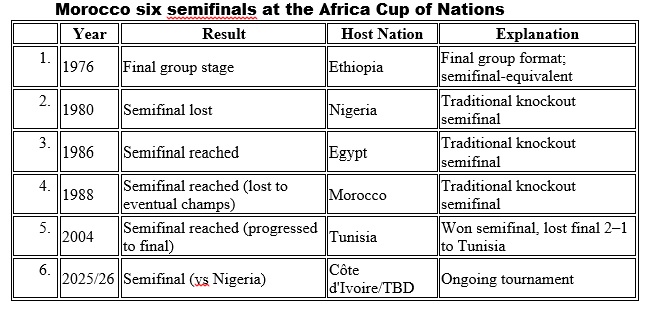
Morocco have reached the Africa Cup of Nations semifinals six times, including the ongoing 2025/26 tournament. That figure, modest when set against their talent pool and global stature, underscores the central tension of their AFCON identity: a nation capable of reshaping narratives on the world stage, yet still searching for sustained authority in Africa’s most exacting competition.
Editorial Note:
The 1974 and '76 Africa Cup of Nations employed a final group stage to determine the champion rather than a standalone semifinal match. Morocco’s qualification for, and performance in, that decisive round is therefore widely treated as a semifinal-equivalent appearance in historical records, reflecting how the tournament’s last four were effectively determined at the time.