BUILT FOR THE STORM: Why the Africa Cup of Nations Feels Like Home to Nigeria
- Published on January 14, 2026
- By U.S. Machika

As Nigeria prepare to confront Morocco in a defining Africa Cup of Nations encounter, they do so with history not as baggage, but as armour. This is a team for whom AFCON is neither an abstract ambition nor an unresolved dream, but a familiar battleground etched deep into national memory. While others approach the tournament as a test of identity, Nigeria arrive as custodians of its traditions—hardened by decades of triumph, tempered by heartbreak, and renewed through constant reinvention. To understand what Nigeria bring into this showdown, one must first appreciate their enduring, almost instinctive bond with the Africa Cup of Nations.
Nigeria’s AFCON story is written in bold strokes, forged through cycles of ascent, collapse, and return. Making their tournament debut in 1963, the Super Eagles quickly evolved into one of Africa’s most consistent and feared presences. From the outset, Nigerian football embraced a distinctive synthesis of athletic power, expressive flair, and competitive edge. AFCON suited Nigeria’s temperament perfectly: intense, volatile, and unrelenting—an arena that rewards courage, resilience, and adaptability. Where others sought to impose order, Nigeria learned to thrive in confrontation.
The breakthrough came in 1980, on home soil, when Nigeria finally claimed their first Africa Cup of Nations title. That triumph was more than a victory; it was a national release. Buoyed by fervent home support, the Super Eagles swept aside their rivals and asserted themselves as continental champions with unmistakable authority. It was a moment that recalibrated Nigeria’s relationship with the tournament, transforming expectation into entitlement and participation into dominance.
Nigeria would return to the summit twice more—lifting the trophy in 1994 in Tunisia and in 2013 in South Africa. Each success belonged to a different generation, shaped by distinct tactical philosophies and playing identities, yet bound by a shared instinct for timing. Nigeria have often peaked precisely when it mattered most, navigating hostile environments, surviving punishing group stages, and delivering clarity under pressure in the tournament’s sharpest moments. AFCON has rarely demanded perfection from Nigeria; it has demanded presence of mind—and they have consistently supplied it.
Even in years without silverware, Nigeria have remained familiar occupants of the tournament’s decisive rounds. Multiple runner-up finishes and numerous third-place results testify to a side that understands how to endure deep into competition. The Super Eagles have repeatedly rebuilt in transit, arriving at AFCON with evolving squads while retaining a collective memory of how the tournament must be approached. Defeats have been absorbed, lessons learned, and momentum quickly restored.
In the modern period, their AFCON journey has been defined less by unbroken dominance than by resilience and relevance. Transitional phases and early exits have alternated with deep, purposeful runs—including a third-place finish in 2019 and consistent progression into recent knockout stages. Unlike some rivals, Nigeria have not always arrived accompanied by global hype or labelled automatic favourites; instead, they have relied on something more enduring: tournament intelligence—the instinctive understanding of when to conserve energy, when to endure pressure, and when to strike decisively.
What ultimately distinguishes Nigeria is not merely the accumulation of titles, but their deep comfort within AFCON’s emotional climate. The Super Eagles are rarely unsettled by hostility, unpredictability, or disorder. Hostile crowds, uneven pitches, officiating inconsistencies, and sudden swings in momentum are not viewed as disruptions, but as conditions to be managed. AFCON consistently rewards teams capable of suffering without panic and improvising without losing structural discipline.
Historically, Nigeria have mastered this delicate equilibrium. This is why the Africa Cup of Nations so often reveals Nigeria at their most authentic. While their global performances have fluctuated with cycles of transition and regeneration, their continental identity has remained remarkably intact. The Super Eagles do not require AFCON to bend to them; they bend, adapt, and recalibrate to the tournament’s demands. AFCON speaks a language Nigeria have learned fluently over decades of exposure and experience.
As Nigeria step into another high-stakes encounter, they do so with an understanding that history offers no guarantees—but it does confer belief. AFCON has tested them, humbled them, rebuilt them, and crowned them. It is a competition they approach not with entitlement, but with deep respect, precisely because it has shaped their footballing consciousness. For Nigeria, the Africa Cup of Nations is not an unfinished story awaiting resolution. It is a living narrative—rewritten by each generation, reinforced by institutional memory, and propelled by a quiet certainty that when Africa’s most demanding football questions are posed, the Super Eagles will almost always be among those expected to answer.
Nigeria at AFCON — The Numbers at a Glance
- AFCON Appearances: 21
- Titles: 3
- 1980 — Nigeria
- 1994 — Tunisia
- 2013 — South Africa
- Runners-up: 4
- Third-Place Finishes: 8
- Recent Highlights:
- 2019 — Third place
- Regular appearances in knockout stages across recent editions
- AFCON Identity: Physically assertive, mentally resilient, emotionally attuned to tournament football
Against this statistical and historical backdrop, Nigeria approach the semi-final against Morocco with quiet confidence rather than loud prediction. The Super Eagles are not chasing novelty; they are navigating familiar terrain. Their AFCON pedigree, reinforced by consistency rather than spectacle, positions them as a side comfortable with pressure and expectation.
Nigeria’s current campaign has further strengthened that narrative. The team that eliminated Algeria has combined emerging unity with competitive edge, suggesting a side growing sharper with each passing round. Rather than dwelling on Morocco’s historic World Cup exploits in Qatar, Nigeria’s focus has remained firmly continental—grounded in the rhythms and realities of AFCON football.
From a performance standpoint, Nigeria’s tournament metrics underline their competitiveness. The Super Eagles have recorded the highest team performance index, scoring 14, ahead of eliminated heavyweights Senegal (11) and Côte d’Ivoire (10). In attacking intent, Nigeria have also led the charts with 84 total shots, marginally ahead of Côte d’Ivoire (83) and Senegal (82), with Morocco trailing outside the top cluster.
Ball circulation further illustrates Nigeria’s control profile. With 2,466 completed passes, the Super Eagles rank just behind Senegal (2,489), and ahead of several other contenders, reflecting an ability not only to engage physically but to manage tempo and territory. These figures collectively suggest a team capable of imposing itself across multiple phases of play.
None of this guarantees victory—AFCON rarely rewards assumption. But it does explain why Nigeria enter this semi-final with belief anchored in evidence rather than emotion. Their strength lies not in proclamations, but in patterns: of presence, pressure, and persistence.
For Nigeria, this match is not about flying past an opponent or dismissing past achievements. It is about doing what they have repeatedly done at AFCON—absorbing the moment, reading the contest, and responding with authority when the margins tighten.
Nigeria – AFCON Semifinal Appearances (17)
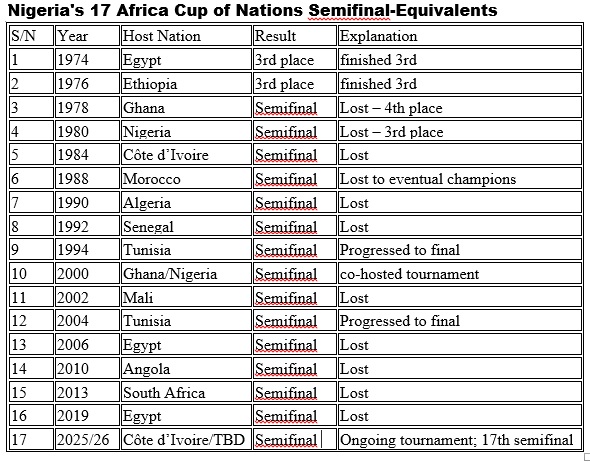
Nigeria’s national team have reached the decisive last-four stage of AFCON on 17 occasions, including the 2025/26 edition. Their first appearance at this advanced stage dates back to 1978. AFCON formats have not always followed a conventional knockout structure, particularly in earlier editions. The 1974 and ‘76 edition used final group-stage format instead of traditional knockout semifinals. Nigeria advanced to this final group and finished third overall, which functionally counts as a semifinal-level performance.