
THE ZAZZAU EMIRATE HUFFAZ PROGRAMME: Can I'timād Al-Huffāz Be an Institutional Identity?
- Published on November 22, 2026
- By U.S. Machika
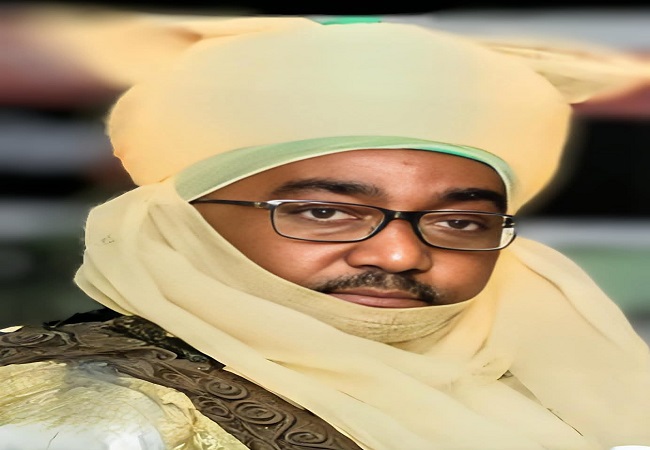
His Highness
Ambassador Ahmed Nuhu Bamalli, CFR
The Emir of Zazzau
I intend this to be a comprehensive read rather than a conventional journalistic feature. It is therefore somewhat longer, but the subject demands the necessary space for a proper examination of the issues.
The Hausa have a saying: “Gyara kayan ka baya za ma sauke, mu raba.” Little did I know that my modest recommendation of I'TIMĀD AL-HUFFĀZ as the permanent brand identity for the Zazzau Emirate's annual Huffaz Programme would be taken seriously enough to generate such an intense debate.
The response has been considerable. I have received numerous messages expressing support for the proposed name, particularly from people who consider it an appropriate reflection of the programme's purpose and the Emirate's institutional standing. There have also been reservations from those who question the use of the Arabic expression I'timād.
Their principal argument is that the term means accreditation and should therefore be reserved for government-authorised institutions or bodies empowered to award certificates recognised for employment and other formal purposes.
I welcome the debate. Indeed, the interest it has generated is itself an indication that the proposed identity has stimulated a conversation worth having. I am grateful to everyone who has expressed an opinion, whether in support of the recommendation or in disagreement with it.
As a matter of intellectual responsibility, I believe both positions deserve consideration. My intention is not to dismiss those who have raised objections, nor to defend a proposal simply because I originated it. Rather, I wish to examine the linguistic meaning of I'timād, the nature and application of accreditation, the traditional recognition of Islamic scholarship, and the institutional authority under which the Zazzau Emirate intends to assess and recognise its young Qur'anic memorisers.
The central question is straightforward: must the use of I'timād necessarily imply government accreditation, or can a recognised traditional institution employ the term to describe the formal assessment, approval and endorsement of individuals who have satisfied its prescribed scholarly requirements?
To answer this, we must first distinguish between the meaning of a word and the particular institutional application it may acquire.
In Arabic, I'timād (اعتماد) is not restricted to the English word accreditation. Depending on its context, it conveys approval, confirmation, authorisation, endorsement, adoption and reliance. The Arabic expression is used in administrative, financial, diplomatic and institutional settings, among others. Its application to educational accreditation is therefore one recognised usage, not the entirety of its linguistic meaning.
This distinction matters because a specialised meaning should not be mistaken for an exclusive meaning. A word may acquire a prominent technical application without losing its wider linguistic significance or becoming unsuitable for other institutional purposes.
I acknowledge, however, that accreditation has acquired a specialised meaning in modern education and professional regulation. In Nigeria, the National Universities Commission has statutory responsibilities concerning the accreditation of university institutions and academic programmes. Section 15 of the National Universities Commission Act defines accreditation within that educational context as a system for recognising institutions and their programmes against standards of performance, integrity and quality. The Commission's official mandate similarly concerns institutional and programme accreditation within the Nigerian university system.
This is a legitimate and important regulatory function. The Zazzau Emirate cannot, by adopting the word I'timād, confer NUC accreditation, government-recognised academic qualifications or professional credentials on its candidates. Neither should the proposed programme be presented as an alternative to statutory educational accreditation.
But this is not what the proposed name seeks to accomplish.
The distinction that appears to have been overlooked is that accreditation and institutional recognition can operate in different fields and within different scopes of authority. The authority to recognise an achievement in one institutional setting does not automatically confer authority to award qualifications in another.
Consider the application of accreditation in sports. Athletes, coaches, officials, journalists and delegates are accredited for recognised competitions and sporting events. Organising bodies establish procedures to verify identities, confirm designated roles and authorise access to official facilities. The accreditation is valid within the scope of the event and the authority of its organisers. It does not make the sporting organisation a government-accredited university or confer academic qualifications on those accredited.
The same principle applies to conferences, seminars and professional gatherings. Speakers, journalists, delegates, exhibitors and participants may undergo verification and accreditation before being admitted or recognised in their designated capacities. The organising institution establishes the requirements, determines who qualifies and confers the relevant recognition. Such accreditation has a defined purpose and institutional scope; it does not automatically translate into a government-recognised academic or professional qualification.
These examples are important because they demonstrate that the word accreditation is not exclusively confined to government-regulated educational institutions. Its application must be understood in the context of what is being accredited, by whom, against which standards and for what purpose.
Why, then, should the word be considered inappropriate when a recognised traditional institution seeks to assess and recognise individuals within its own defined sphere of responsibility?
The essential considerations should be the legitimacy of the institution, the standards it establishes, the integrity of its assessment and the scope of the recognition it confers. These are the considerations against which the Zazzau Emirate's proposed application should be examined.
There is another dimension to this debate that deserves attention: the suggestion that the programme should adopt more traditional Islamic scholarly expressions such as Ijāzah, Shahādah, Tazkiyah or Tasdiq instead of I'timād. I consider these suggestions worthy of examination, but I do not believe that their traditional associations automatically make them more appropriate for the purpose at hand.
Each expression carries its own meaning and application. Ijāzah (إجازة), for instance, has a particular place in Islamic scholarship. It commonly refers to an authorisation granted by a qualified teacher or scholar permitting a student to transmit knowledge, a particular text or Qur'anic recitation, often through an established chain of transmission known as Sanad. Shahādah (شهادة) may refer to testimony or a certificate confirming an achievement. Tazkiyah (تزكية) conveys commendation, validation or attestation, while Tasdiq (تصديق) communicates confirmation or verification.
These expressions are related to recognition in different ways, but they are not interchangeable. More importantly, the Zazzau Emirate is not necessarily granting every successful candidate an authorisation to transmit Qur'anic recitation through a recognised Sanad. Its programme is designed to examine, verify and formally recognise the achievement of those who have memorised the Holy Qur'an and satisfied the requirements of its additional scholarly assessment.
The terminology should therefore describe what the Emirate actually does, rather than what we might prefer it to be doing. A traditional expression should not be selected merely because it sounds more familiar to Islamic scholarship, just as a modern administrative expression should not be adopted merely because it sounds more institutional.
The historical traditions of Hausaland provide another compelling dimension to this discussion.
Zazzau, and particularly Zaria, has long been associated with Islamic scholarship and learning. The historic description Zazzau, Zaria Birnin Ilimi is not merely an ornamental expression; it reflects an inherited intellectual and religious identity. For generations, scholars and students have travelled across Hausaland in pursuit of Islamic knowledge, instruction and scholarly recognition.
Traditional centres of learning, including Gidan Kona in Zaria, have formed part of this intellectual heritage. The scholarly tradition associated with such centres illustrates how recognised teachers and institutions examined, instructed and validated the learning of individuals. The wider intellectual connections among Zaria, Yandoto, Katsina and Kano also demonstrate that Islamic scholarship in Hausaland developed through relationships between established centres of learning, their scholars and their students.
The historical practice of seeking scholarly examination and recognition from respected authorities was not dependent on the existence of modern government accreditation agencies. Its authority rested on the standing of the scholars, the credibility of the institutions and the standards of learning they upheld. This should not be confused with modern statutory accreditation, nor should every traditional scholarly recognition be described as an Ijāzah or Sanad. The point is that the recognition of knowledge and scholarly achievement has historically operated within its own established intellectual and religious frameworks.
This tradition is important to the present discussion. It demonstrates that the authority to recognise religious learning and scholarly achievement is not conceptually confined to government-regulated educational institutions. Different institutions exercise recognition within their respective spheres, provided their standards, procedures and claims are properly defined.
The Zazzau Emirate's Huffaz Programme must be considered within this context.
The initiative is not simply an annual gathering at which Islamic schools present their graduating students for ceremonial recognition. Individual schools undertake their own teaching, memorisation, assessment and graduation ceremonies. The Emirate has introduced an additional level of scholarly examination through a panel involving recognised Islamic scholarly titleholders under the leadership of the Sarkin Malamman Zazzau, alongside selected Qur'anic scholars, professors, academicians and preachers, all of whom are renowned Huffaz.
Candidates undergo further assessment beyond the graduation processes of their respective schools before those who satisfy the requirements are presented for Emirate-level recognition.
This is a significant institutional distinction. The Emirate is not claiming to have taught every candidate or to replace the schools responsible for their formation. Rather, it has established an additional process through which their achievements are examined and formally recognised within its traditional and religious framework.
I consider this the foundation upon which the proposed identity should rest.
The word I'timād expresses more than the presentation of certificates or the ceremonial endorsement of young people. It communicates formal approval, recognition and institutional validation. The proposed expression, I'TIMĀD AL-HUFFĀZ, therefore gives the programme a distinct identity beyond its description as an annual gathering.
The accompanying descriptor — “Zazzau Emirate Authenticated, Accredited and Endorsed Qur'anic Memorisers” — is intended to communicate three related but distinguishable elements of the process.
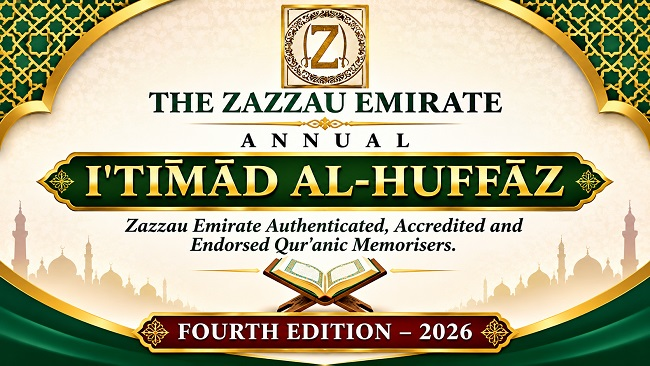
Authentication establishes that the candidate's claim to have memorised the Holy Qur'an has been examined. Accreditation signifies recognition that the candidate has satisfied the scholarly requirements established by the Emirate's assessment framework. Endorsement represents the formal approval and recognition of the candidate by the Emirate.
These are not three unrelated awards, nor are they claims to government certification. They describe the process and outcome of scholarly verification and institutional recognition. Their use must be supported by clearly defined assessment criteria, recognised examiners, consistent procedures and a properly documented approval process. An institutional name must be supported by institutional substance.
There is also an important question about the expectation that a proposed institutional identity must have been used by another organisation before it can be considered legitimate. I find this position difficult to accept as a general principle. If every new institutional idea had to establish a precedent before it could be considered, the development of new concepts, theories, frameworks and bodies of knowledge would be severely constrained.
Institutions acquire identities, establish standards and develop procedures because someone recognises a need and has the conviction to propose a framework that did not previously exist in that particular form. The absence of precedent may invite closer examination, but it is not, by itself, evidence of impropriety.
The Zazzau Emirate's Huffaz Programme operated for four editions without a permanent institutional identity. Identifying that gap and recommending I'TIMĀD AL-HUFFĀZ was my contribution to the continuing development of the initiative. I did not propose the name to elevate the programme beyond its actual standing, or to suggest that the Emirate possesses regulatory powers reserved for government institutions. My intention was to identify an expression that captures its defining purpose: the further assessment, authentication, accreditation and formal endorsement of Qur'anic memorisers within the Emirate's traditional and religious sphere of responsibility.
Gyara kayan ka baya za ma sauke, mu raba. The moment one proposes to improve an existing arrangement, one must be prepared for disagreement, scrutiny and the possibility of being asked to defend the proposed improvement. That is not a reason to abandon the exercise. It is an invitation to strengthen the proposal, address legitimate concerns and distinguish constructive criticism from objections founded merely on unfamiliarity.
I recognise that some people have expressed reservations about whether I can adequately defend the proposed name before His Highness or other stakeholders. I understand the caution, particularly where the implications of terminology and institutional recognition are concerned. But caution should lead to a more rigorous examination of the proposal, not an automatic retreat from it. The absence of an established precedent should encourage intellectual inquiry, not prevent it.
Ultimately, the choice of a permanent brand identity rests squarely with His Highness, Ambassador Ahmed Nuhu Bamalli, CFR, who initiated the programme and has the authority to determine the institutional direction he considers appropriate, within the applicable laws and regulations. My responsibility, as the person who proposed the name, is not to secure its adoption through appeals to authority or personal persuasion. It is to present the strongest possible intellectual and institutional case for it.
I am conscious that His Highness may wish to hear further explanations or seek the views of Islamic and Arabic language scholars whose opinions he respects. It is a welcomed engagement. Indeed, the opportunity to subject the proposal to serious scholarly examination would be a positive outcome of this debate. The name should be tested on its linguistic accuracy, institutional relevance and practical implications, not accepted or rejected simply because it is new.
My position, therefore, remains that I'TIMĀD AL-HUFFĀZ is an appropriate and defensible expression for the identity we seek to establish. I have not arrived at this position merely because I proposed the name. I have considered the objections, examined the linguistic argument, evaluated the alternatives and reflected on the institutional character of the programme.
A name should not be adopted simply because it sounds impressive. It should express what an institution does, the authority under which it operates and the standards by which it wishes to be judged. If the Zazzau Emirate is prepared to sustain the assessment framework behind the name, then I'timād Al-Huffāz is more than an appropriate title. It is an institutional statement of purpose.
The debate has therefore served a useful purpose. It has compelled us to examine not only a proposed name but also the standards, procedures and institutional responsibilities that must give that name meaning.
Gyara kayan ka baya za ma sauke, mu raba. Constructive disagreement is not the enemy of institutional progress. Properly engaged, it can become the instrument through which an idea is refined, tested and strengthened.
We should not reject an institutional identity because it is new; we should examine whether it is accurate, legitimate and worthy of the institution it seeks to represent.
The name should stand on the strength of the institution behind it, and the institution should earn its distinction through the integrity of the process it upholds.
That is the case for I'TIMĀD AL-HUFFĀZ.