
IYA ALU MEMORIAL SCHOOLS ZARIA: The Intent Was Not a School, It Was to Immortalise
- Published on November 10, 2026
- By U.S. Machika
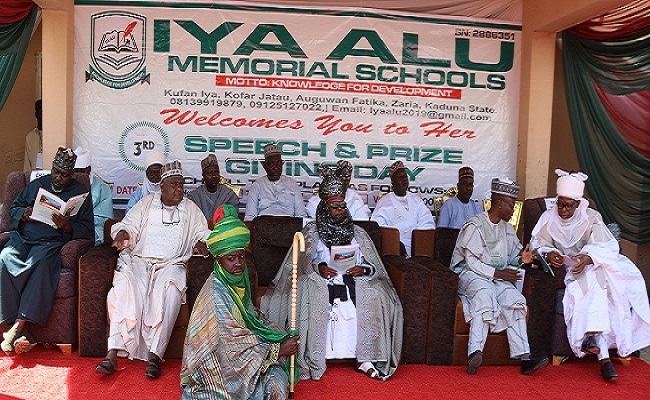
The Third Speech and Prize-Giving Day of Iya Alu Memorial Schools
I was not there as a journalist. I was there as a guest. It was the Third Speech and Prize-Giving Day of Iya Alu Memorial Schools. The school's substantial infrastructure and facilities reflected a well-developed educational establishment. However, as I sat through the proceedings and observed the presentations and activities of the day, it dawned on me that “The intent was not a school. It was to immortalise.”
There and then, I resolved to dig deeper, recount what I had witnessed and trace the story back to its historical beginnings.
A school is fundamentally established to educate, equip and prepare generations for the future. Some, however, are conceived with a broader social responsibility: to serve as instruments of community development, advance collective aspirations and contribute to the transformation of society. Yet, beyond these purposes lies an even more uncommon ambition: to establish an institution not merely for what it can accomplish in the present, but for what it is intended to preserve for posterity. Such an undertaking transcends the conventional understanding of education.
That, precisely, was what I witnessed at the Iya Alu Memorial Schools’ Speech and Prize-Giving Day. Beneath its educational identity lies a deeper historical purpose; its existence is driven by a historical consciousness.
At first encounter, the name suggests another addition to the growing landscape of private education. Yet, its character and operations reflect those of a fully-fledged community school.
On the surface, naming the school after Iya Alu might appear to follow the familiar practice of commemorating distinguished personalities by naming monuments, public institutions and infrastructure after them. Yet, the circumstances surrounding its establishment reveal a fundamentally different intention. This was not a case of establishing an institution and subsequently naming it after a distinguished personality in recognition of his accomplishments. Rather, the personality came first; the institution was conceived as the means of immortalising him. It was a deliberate determination to preserve the memory of a historical figure, perpetuate an ancestral heritage and give enduring expression to a dynasty whose place in the history of Zazzau deserves to be remembered.
One must travel backwards through the corridors of Zazzau's history to understand why the intention was not merely to establish a school, but to immortalise. This requires an examination of the ancestry, identity and continuity of a ruling house within the traditional institution of Zazzau.
Iya Alu was the eldest son of Malam Abdulkarim Ibn Abbas, the third Emir of the Fulani Dynasty of Zazzau and founder of the Katsinawa Ruling House. Unlike the eldest sons of the first two Emirs of the Fulani Dynasty, Iya Alu did not ascend the throne following his father's demise. Instead, the throne passed through six Emirs over seven separate reigns during the approximately thirty-two years following his father's death.
Under the traditional succession principle, princes whose fathers had not occupied the throne were not considered eligible to become Emirs of Zazzau. This explains why Iya Alu's lineage would ordinarily have been excluded from succession under the established convention.
However, a significant departure occurred with the accession of Malam Jafar Ibn Ishaq in 1937. Although his father had not occupied the throne, his accession established a precedent for succession through a grandson of an Emir. Thereafter, four successive Emirs emerged from this category of royal descent, progressively transforming what had begun as a departure from the established convention into an accepted succession practice.
The significance of this historical development extends beyond the succession of individual Emirs. It highlights the distinction between occupying the throne and sustaining a royal lineage. Although Iya Alu never became Emir, his lineage remained woven into the continuing history of the Zazzau Emirate. His historical significance must therefore be understood not through a throne he never occupied, but through the dynasty and generations whose ancestry is traced to him.
Iya Alu’s ancestral settlement, known as Kufan Iya Alu, is located in Kofan Jatau, Anguwan Fatika, Zaria. The approximately seven-hectare settlement dates back to 1834. Following his demise, his descendants reportedly relocated to different places, leaving it deserted for about forty to fifty years. It was subsequently used as farmland for a similar period before being distributed among the descendants of six of his children: Iyan Zazzau Abdurauf, Mardannin Zazzau Muhammad Bello, Malam Abdulsalam, Malam Maikako, Malam Abe and Malam Abbas.

Malam Bashir Abubakar, ACG, NCS (Rtd), MFR
Barden Kudun Zazzau
From this inheritance emerged a new chapter. Malam Bashir Abubakar, ACG, NCS (Rtd), MFR, Barden Kudun Zazzau, acquired the portion belonging to the family of Malam Abe. But what followed distinguished the acquisition from an ordinary property transaction. Rather than treating the land simply as another family asset, he chose to immortalise Iya Alu.
The story of Iya Alu Memorial Schools is therefore connected to a particular place, an ancestral settlement and a piece of land whose historical significance would eventually acquire an entirely different expression.
Iya Alu Memorial Schools does not merely bear the name of a historical personality; it stands upon a portion of the ancestral land he bequeathed to his descendants. There is something profoundly symbolic about this convergence of a man, his ancestral settlement and an institution established in his memory. The land that once accommodated generations of his descendants has acquired a new purpose, yet its historical identity remains intact, finding renewed expression through an institution dedicated to immortalising its original owner.
If the intent was not a school, but to immortalise Iya Alu, why then was a school the chosen vehicle?
Iya Alu was remembered as a man of considerable wealth, learning and personal virtue, qualities whose influence endured through succeeding generations. These accounts invite a deeper examination of his life beyond his relationship with Malam Abdulkarim Ibn Abbas and his place in the emergence of the Katsinawa Ruling House. What distinguished his intellectual accomplishments? What was the extent of his wealth and influence? How did his values shape the generations that followed?
These questions demand historical investigation, not merely celebratory recollection. Immortalisation is not simply about preserving a name, but recovering the story, character and historical circumstances that give it meaning.
Perhaps the answer to why a school lies partly in the very personality Malam Bashir Abubakar sought to immortalise. If Iya Alu was remembered for his scholarship, what more enduring expression of that legacy could there be than an institution devoted to learning? Malam Bashir could have pursued other undertakings, from infrastructural development to a non-governmental organisation or commercial venture. Yet, he chose education, giving the ancestral land a new institutional purpose: a community school bearing the name of his grandfather, Iya Alu.
The choice was significant. Rather than commemorate Iya Alu through a monument that merely preserved his name, Malam Bashir established an institution whose enduring purpose would be to transmit knowledge, cultivate character and prepare succeeding generations. The school thus does more than commemorate a man remembered for his learning; it gives practical and continuing expression to that legacy.
If the overriding intention had simply been to establish a commercial private school, Malam Bashir Abubakar could have chosen locations with greater commercial potential, perhaps in Kaduna, Abuja or a more metropolitan part of Zaria. Instead, he chose Iya Alu’s original ancestral settlement, a portion of the original holding deserted for generations, with limited room for expansion.
His commitment extended beyond the choice of location and the provision of modern educational infrastructure. He subsidised school fees and personally financed its operations for the first three years, including staff salaries and other recurrent expenses, until it attained financial sustainability. These commitments reflected an undertaking that went beyond commercial enterprise: making education accessible, sustaining its delivery and giving practical expression to the historical purpose that inspired the institution.
In that decision lies one of the most compelling dimensions of this story: an ancestral inheritance became the foundation of an institutional undertaking, giving the land a renewed purpose while preserving the memory of the personality from whom its historical significance originated.
There is a distinction between inheriting history and accepting the responsibility of preserving it. The former is often a consequence of birth; the latter is a conscious decision. While ancestry establishes one's connection to the past, what one chooses to do with that inheritance determines one's contribution to the future.
This distinction provides an important entry point into understanding the vision behind Iya Alu Memorial Schools.
As I watching the proceedings of the Third Speech and Prize-Giving Day of Iya Alu Memorial Schools, it dawned on me that “The intent was not a school. It was to immortalise.”
Perhaps, in that simple yet profound declaration, lies the story of Iya Alu Memorial Schools, Zaria.
I intend to dig deeper and tell that story.