
FROM SAMARU'S STREETS TO THE PALACE: LEGASi, YES CLUB Take Electoral Peace Campaign to the Community
- Published on November 27, 2026
- By U.S. Machika, Umar Sulaiman & Peace Moses
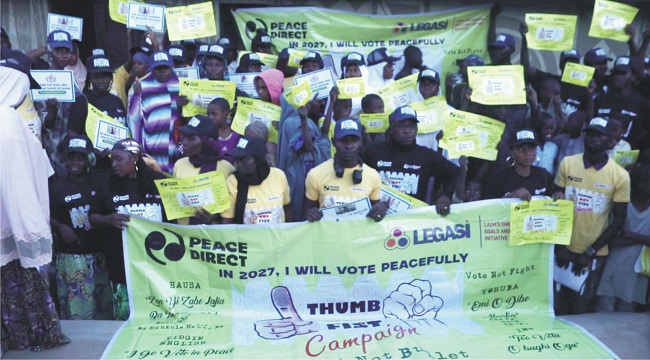
A youth-led peace campaign has taken its message directly to the streets and traditional institutions of Samaru, Zaria, with the Ladies Empowerment Goals and Support Initiative (LEGASi) and the Youth Equipped for Service Initiative (YES CLUB) urging young people to reject electoral violence and embrace peaceful democratic participation ahead of Nigeria's 2027 general elections.
Led by its President and Lead Coach, Mr Wilson John Kagwari, YES CLUB mobilised approximately 50 participants, about 30 of them women, for the community sensitisation exercise, which took the campaign's message through several neighbourhoods and traditional institutions in Samaru and New Extension.
Kagwari, who also served as Rally Coordinator, was supported in the exercise by Assistant Lead Coach, Bitrus Bulus; Secretary, Maryam Adamu; and Programme Manager, Edward S. Jonathan. The grassroots mobilisation also received support from the club's women leaders in the participating communities: Fatima Musa in Anguwan Gwaiba and Mary Obadiah in New Extension. Their involvement helped mobilise women to participate in the exercise.
Held on Wednesday under the banner of THUMB NOT FIST – BALLOT NOT BULLET, the awareness campaign sought to encourage young people to exercise their democratic rights through the ballot rather than resorting to violence, intimidation or physical confrontation. Its central message was that elections should provide an avenue for citizens to express their political choices, not become a trigger for conflict, hostility and division. Captured in the appeal, “Use Your Thumb, Not Your Fist”, the campaign drew a deliberate distinction between the thumb, symbolising the democratic right to vote, and the fist, representing violence and aggression. It urged young people to channel their political convictions through the ballot rather than physical confrontation.
The organisers' message is particularly relevant to young people, who are often at the centre of political mobilisation and whose participation can either strengthen democratic processes or expose communities to electoral violence. The campaign therefore called on them to recognise their influence and responsibility as citizens, making their votes count without allowing political differences to degenerate into violence.
In preparing for the exercise, YES CLUB also sought professional guidance on communication, stakeholder engagement and coordination to ensure that the campaign was properly organised, conducted and publicised, with due consideration for relevant institutions and public safety.
From the planning stage, YES CLUB informed the Independent National Electoral Commission (INEC), recognising its importance as a major stakeholder in the promotion of credible and peaceful elections. The club also informed and maintained communication with the Divisional Police Officer of the Nigeria Police Force, Samaru Division, while notifying other security agencies, particularly the Department of State Services (DSS), Sabon Gari Directorate Command.
It equally sought the cooperation of the Federal Road Safety Corps (FRSC), whose support provided uniformed personnel, traffic marshals and an ambulance to accompany the procession. Armed operatives of the Kaduna State Vigilance Service (KADVIS) also accompanied participants throughout the rally, providing security cover along the route. The FRSC's presence was particularly important as the procession navigated the busy Sokoto Road, a major highway carrying heavy vehicular traffic, including articulated trucks. These arrangements reflected the organisers' effort to translate the campaign's commitment to peace into practical measures for public safety.
The procession commenced at Anguwan Gwaiba in New Extension, where participants were received by the Ward Head, Malam Isah Hamisu. The group crossed the railway line and continued through New Extension, passing the residence of another Ward Head before proceeding to the residence of the Sarkin Gwaiba, Alhaji Rufai Yakubu, where the participants made a stop.
The procession continued through Galadiman Street and Habib Street, where the group stopped to engage Malam Sani Mohammed, an Islamic cleric and member of Jama'atu Nasril Islam (JNI). From there, the participants proceeded towards Funtua Garage, linked up with the main Sokoto Road and continued towards Ahmadu Bello University (ABU), Zaria, reaching the university's North Gate before branching towards the palace of the Sarki of Samaru.
Throughout the route, the procession was accompanied by colourful songs, enthusiastic campaign chants and spontaneous dance displays. Participants moved through the communities with rhythmic songs and energetic expressions of solidarity, drawing the attention of residents and turning the awareness walk into a lively public demonstration of the campaign's message.
The participants were also distinctively identified by customised campaign T-shirts made from 100 per cent cotton fabric. The shirts carried the logos of Peace Direct and LEGASi, alongside an illustration combining a clenched fist and an inked voting thumb. The accompanying four-word campaign inscription was arranged vertically as “THUMB”, “NOT”, “FIST” and “CAMPAIGN”, with “NOT” and “CAMPAIGN” printed in red. Participants also wore matching face caps bearing the fist-and-thumb illustration and campaign wording, although the caps did not carry the organisational logos.
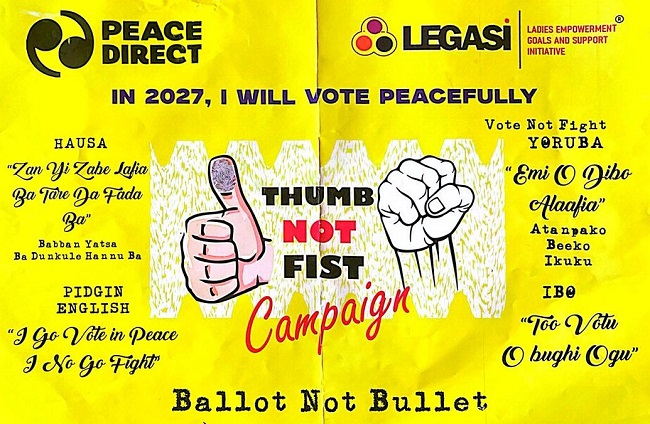
The choice of the thumb and fist as opposing symbols was central to the campaign's communication strategy. Together, they presented a simple but powerful civic proposition: political differences should be resolved through democratic choices, not physical confrontation.
At the palace, the participants were received by the Sarki of Samaru, Alhaji Dauda Abubakar, who offered prayers and counsel, urging the young people to uphold peace, unity and responsible conduct. He emphasised peaceful coexistence and encouraged the participants to remain committed to the values promoted by the campaign. Further solidarity songs accompanied the gathering before the participants dispersed at about 6:20 p.m.
From Anguwan Gwaiba through the streets and communities of Samaru to the traditional institution, the procession carried a reminder that responsibility for peaceful elections does not rest solely with electoral and security agencies. It is also shared by political actors, community leaders and, especially, young people whose participation will help shape the character of the 2027 elections.
The exercise brought together electoral peace, community participation and traditional leadership engagement. By taking the campaign through residential neighbourhoods, engaging a religious leader and seeking the counsel of traditional authorities, YES CLUB placed its message within the community structures that influence public attitudes and behaviour.
The Samaru campaign forms part of a wider peacebuilding intervention involving three distinct institutional levels. Peace Direct, a United Kingdom-based peacebuilding organisation, supports local peacebuilders and community-led initiatives in conflict-affected societies. In Nigeria, it supports the work of LEGASi, a women-led, non-governmental organisation established in 2017 and involved in peacebuilding, women's empowerment, community reconciliation and the prevention of electoral violence. LEGASi, in turn, provides funding to grassroots implementing organisations, including YES CLUB, which takes the campaign's message directly to communities in Zaria.
YES CLUB, whose full name is Youth Equipped for Service Initiative, is a grassroots organisation whose broader mission is to equip young people with the skills, knowledge and resources required to become responsible and empowered contributors to positive social change, peace, sustainable development and nation-building.
Its areas of engagement include peacebuilding, drug-free sensitisation, vocational training for internally displaced persons, sensitisation and training for out-of-school young people, youth capacity development—with particular attention to young women through leadership, financial literacy and entrepreneurship—and the use of sports as a tool for peacebuilding. The Samaru Road Walk therefore forms part of a broader framework of community development and youth participation, rather than an isolated demonstration. It reflects an approach that recognises young people not merely as an audience for peace messages, but as active participants capable of influencing their communities.
The exercise is particularly significant in the context of the approaching 2027 general elections. Electoral violence does not begin and end on Election Day. Its conditions can be cultivated long before voting through political intolerance, inflammatory rhetoric, intimidation, misinformation and the exploitation of young people by individuals seeking political advantage.
Peacebuilding interventions must consequently extend beyond appeals for calm during elections. They must encourage citizens to respect opposing political views, reject violence as an instrument of political expression and recognise that the right to vote carries a corresponding responsibility to respect the choices of others.
The Samaru exercise demonstrated one practical approach to achieving this: taking civic enlightenment directly to the people, engaging traditional and religious authorities, and mobilising young people as advocates of peaceful coexistence. The THUMB NOT FIST – BALLOT NOT BULLET campaign seeks to communicate a message simple enough to be understood across educational, social and linguistic boundaries, yet significant enough to stimulate conversations about democratic responsibility.
Ultimately, the success of such an intervention will not be measured merely by the number of participants who took part in a procession or the streets through which they walked. Its more enduring value will lie in the extent to which its message is understood, embraced and translated into responsible conduct.
The ballot should provide the means through which citizens express their political preferences. Political differences are inevitable in a democracy, but they should never become an excuse for violence, hostility or the destruction of lives and livelihoods. Citizens must be able to express their choices while respecting the rights and choices of others.
From the streets of Samaru to the palace of its traditional ruler, the message was unmistakable: Use your thumb, not your fist. Choose the ballot, not the bullet. Nigeria's democracy deserves peaceful participation.