
Ambassador Ahmed Nuhu Bamalli and the Institutionalisation of Qur'anic Scholarship: From Walima to I'timād Al-Huffāz
- Published on November 20, 2026
- By U.S. Machika

His Highness
Ambassador Ahmed Nuhu Bamalli, CFR
The Emir of Zazzau
For the six years since His Highness, Ambassador Ahmed Nuhu Bamalli, CFR, ascended the throne of Zazzau, I have closely observed his leadership. I bear witness that he has demonstrated that the enduring value of leadership lies not merely in the programmes a leader initiates, but in the structures he establishes, the values he preserves and the legacies he builds. Initiatives born out of genuine conviction require vision, consistency and organisation to evolve into institutional undertakings capable of outliving their originators.
The Zazzau Emirate's annual gathering of Huffaz – those who have memorised the Holy Qur'an – is one such initiative through which His Highness has sought to give institutional expression to his commitment to Qur'anic scholarship.
I consider this initiative particularly significant because it reflects the Emir's determination to preserve and promote Zazzau's historic identity as Birnin Ilimi – the City of Knowledge. Few traditional expressions capture the historical identity of Zazzau as profoundly as Zazzau, Zaria Birnin Ilimi. Beyond being an affectionate description of the ancient city, the epithet reflects its longstanding association with scholarship, Islamic learning, intellectual accomplishment and the transmission of knowledge across generations. It is an identity inherited from successive generations, and one that we have a responsibility to preserve.
In my view, preserving that heritage requires more than celebrating its historical reputation. It demands practical commitments to education, scholarship and the institutions that sustain them. It is within this context that I believe the Emirate's annual programme for Qur'anic memorisers deserves to be understood.
Upon ascending the throne, Ambassador Bamalli personally honoured invitations to the Walima of graduating Huffaz across his domain. His presence was an expression of encouragement to Islamic schools, their teachers, parents and the young people who had committed themselves to memorising the Holy Qur'an. I regard this personal involvement as an important part of the programme's history: it demonstrated the value he attached to Islamic scholarship and those responsible for preserving it.
However, sustaining such personal attendance across 31 districts and 11 local government areas presented an enormous logistical undertaking. The geographical spread of the Emirate, the number of Islamic schools and the frequency of their graduation celebrations made it increasingly demanding for the Emir to honour individual invitations.
A practical suggestion consequently emerged: rather than having the Emir travel from one Islamic school to another, graduating Huffaz should be invited to the Palace, where he could receive them, offer his royal blessings, endorse their achievements and provide a common platform for their recognition.
That suggestion became the foundation of the programme.
What I find particularly noteworthy is how, approximately two years into his reign, the Emir's personal participation in individual graduation celebrations evolved into an organised Emirate-wide initiative. The arrangement did more than resolve a practical challenge. It created a common platform for royal reception, scholarly assessment and recognition of Qur'anic memorisers drawn from across the Emirate.
The programme's geographical reach is reflected in its distribution arrangements. Each district is expected to present 60 Huffaz, while Zaria and Sabon Gari, given their metropolitan character and larger populations, have allocations exceeding 100 candidates each. To me, this demonstrates the scale of the undertaking and the importance attached to ensuring that the Emirate's different communities are represented.
The Fourth Edition, scheduled for Saturday, 21 November 2026, comes at the tail end of activities marking Ambassador Ahmed Nuhu Bamalli's sixth anniversary on the throne of Zazzau. I consider this an appropriate moment not only to acknowledge the initiative, but also to reflect on the institutional identity it now deserves.
That brings me to a further consideration. As the programme approaches its Fourth Edition, I believe it is time to give it a distinctive and permanent identity.
There is a fundamental difference between naming an event and establishing a brand. A graduation ceremony describes an occasion; a convocation describes an assembly; an investiture describes the formal conferral of an honour or distinction. These expressions may adequately describe particular activities, but none captures the distinctive institutional character of what the Zazzau Emirate is undertaking.
My concern, therefore, was to identify a name that could become synonymous with the Emirate's independent assessment, approval and recognition of Qur'anic memorisers. In my assessment, such a name must communicate the programme's purpose and scholarly character, reflect the authority of the Zazzau Emirate, and be sufficiently memorable and enduring to accommodate successive editions. It must become a brand in its own right.
This is not merely a question of attractive nomenclature. I believe an institutional name should embody the purpose, values and aspirations of the undertaking it represents. The Emirate's Qur'anic memorisation initiative deserves that consideration.
In exploring a befitting identity, I gave particular attention to Arabic expressions associated with verification, authentication, approval, accreditation and scholarly endorsement. This was informed by an important distinction in the programme itself. Individual Islamic schools undertake their own teaching, assessment and graduation of students who have memorised the Holy Qur'an. The Emirate, however, introduces an additional layer of scrutiny.
Through its six recognised Islamic scholarly titleholders, under the chairmanship of the Sarkin Malamman Zazzau, a further assessment brings together Islamic scholars, university professors, academicians, preachers, all renowned Huffaz to examine and verify the candidates. Those who successfully pass this assessment are subsequently approved for presentation at the Emirate's annual gathering.
I consider this distinction central to understanding the programme. The Emirate is not merely organising another graduation ceremony; it is establishing an additional process of scholarly verification and recognition across its 31 districts and 11 local government areas.
That distinction informed my consideration of three Arabic expressions: Taḥqīq, associated with verification and establishing authenticity; Taṣdīq, associated with confirmation and attestation; and I'timād, which conveys formal approval, accreditation and endorsement.
Of these, I'TIMĀD AL-HUFFĀZ presents, in my considered judgement, a compelling proposition.
In Arabic, I'timād (اعتماد) conveys accreditation, formal approval or endorsement, while Al-Huffāz (الحفاظ) refers to those who have memorised the Holy Qur'an. Together, the proposed name gives the initiative a distinctive identity associated with the formal approval and recognition of Qur'anic memorisers.
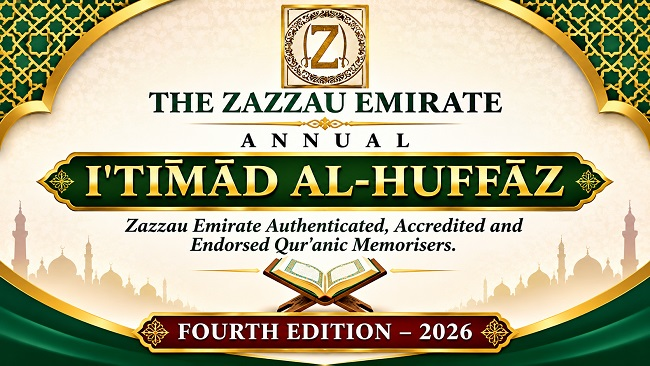
I am persuaded by this choice because it speaks directly to what His Highness, Ambassador Ahmed Nuhu Bamalli, sought to achieve through this initiative. The programme establishes a distinction between the Emirate's exercise and the ordinary graduation of students. Candidates undergo an additional assessment against a recognised scholarly standard before receiving the Emirate's endorsement. The proposed name therefore does not simply rename an existing gathering; it expresses the programme's defining institutional purpose.
I propose that the brand be presented as follows:
THE ZAZZAU EMIRATE
ANNUAL
I'TIMĀD AL-HUFFĀZ
Zazzau Emirate Authenticated, Accredited and Endorsed Qur'anic Memorisers.
FOURTH EDITION – 2026
In my considered view, I'TIMĀD AL-HUFFĀZ captures the central purpose of the initiative conceived under Ambassador Bamalli's patronage. I therefore recommend its formal adoption by the Zazzau Emirate as the programme's permanent institutional brand, subject to confirmation by the recognised Islamic scholars that the terminology accurately reflects the status conferred on successful candidates.
The Fourth Edition would provide an appropriate opportunity to introduce this identity and establish consistency for subsequent editions. The Fifth Edition, Sixth Edition and those that follow would retain the same institutional name.
I would also propose a permanent register of successful candidates, the preservation of assessment records and an institutional history of those authenticated and recognised by the Emirate. Such measures would strengthen continuity, accountability and public confidence while providing a verifiable record for future generations.
I believe Ambassador Ahmed Nuhu Bamalli deserves commendation for recognising that preserving Zazzau's identity as Birnin Ilimi requires practical investments in learning and scholarship. His personal attendance at individual Walima, the eventual creation of a common Palace platform and the subsequent organisation of an Emirate-wide assessment programme illustrate a progression from personal patronage to institutional development.
The initiative has also demonstrated the value of collective support. Its development from sole sponsorship to government support, alongside additional interventions by local government administrations, illustrates the importance of partnerships in sustaining programmes of this nature.
For me, I'TIMĀD AL-HUFFĀZ is more than a proposed name. It is an opportunity to give greater structure, visibility and continuity to the Zazzau Emirate's commitment to Qur'anic scholarship.
Having followed this initiative from its origins in the Emir's personal attendance at individual Walima to its emergence as an Emirate-wide assessment and recognition programme, I believe its evolution is worthy of documentation. For Zazzau, Birnin Ilimi, preserving the heritage of knowledge requires more than remembering its past. It requires building institutions that will carry that heritage into the future.
And perhaps therein lies the enduring significance of Ambassador Ahmed Nuhu Bamalli's contribution to this particular initiative: a tradition worthy of preservation deserves an institution worthy of its legacy.