
Ambassador Ahmed Nuhu Bamalli and the Institutionalisation of Qur'anic Scholarship-II: From Personal Sponsorship to Collective Ownership – Sustaining the Zazzau Emirate's Huffaz Initiative
- Published on November 22, 2026
- By U.S. Machika
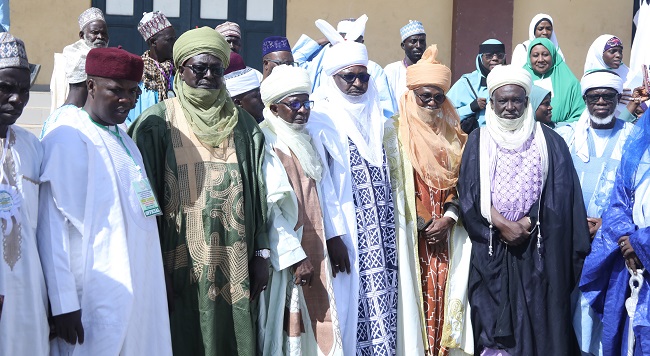
Cross-section of Officials and Participants at the Fourth Edition of the Zazzau Emirate's Annual Huffaz Programme, Held on Saturday, 21 November 2026
The Fourth Edition of the Zazzau Emirate's annual Huffaz Programme, held on Saturday, 21 November 2026, brought together Qur'anic memorisers from across the Emirate's 31 districts and 11 local government areas. The gathering took place at the multi-purpose spectator pavilion in front of the Zazzau Palace, between 10:00 am and 1:30 pm, reaffirming the Emirate's commitment to recognising and encouraging young people who have committed the Holy Qur'an to memory.
Beyond the gathering itself, however, I believe the occasion raises a more fundamental question: how can an initiative conceived and sustained through the personal commitment of His Highness, Ambassador Ahmed Nuhu Bamalli, CFR, become a lasting responsibility shared by the institutions and communities it serves?
When the programme was introduced, His Highness took personal responsibility for its sponsorship, allowing it to take root within the limits of what could reasonably be sustained. Its growing reach and institutional significance now make a wider support structure increasingly necessary. I consider this transition essential. An initiative may begin with one person's conviction and generosity, but its endurance depends on the wider community accepting it as a collective responsibility.
The Kaduna State Government, under Senator Uba Sani, has made annual financial contributions towards the programme. This support is commendable because it recognises Qur'anic scholarship as part of the educational and cultural heritage of the state. There is, however, another level of ownership that deserves greater attention: the responsibility of the eleven local governments within the Zazzau Emirate.
The figures presented at the programme provide an important basis for this discussion. Of the 1,604 Huffaz represented, Zaria recorded the highest number, with 361, followed by Kubau with 232 and Makarfi with 185. Together, these three local governments accounted for 778 candidates, approximately 48.5 per cent of the total. At the other end, Ikara recorded 89, Giwa 51 and Kudan 34, a combined 174 candidates, or approximately 10.8 per cent.
The differences are considerable. They should prompt district authorities, Islamic schools and local governments to examine the circumstances behind them. Do they reflect population, the concentration of Islamic schools, the number of Huffaz produced by the respective communities, the level of mobilisation or other factors?
The district figures reinforce the need for such reflection. Zaria (Kewaye) recorded 242 candidates, Makarfi 128 and Zaria (Waje) 119. Together, they accounted for 489 candidates, approximately 30.5 per cent of the overall figure. Meanwhile, twenty of the 31 districts recorded fewer than the reference allocation of 60 candidates expected from each district.
These numbers should not, in isolation, be treated as a measure of any district's performance or its leadership's commitment. That judgement would require further information about the availability of Islamic schools, and local circumstances. Nevertheless, the figures offer a useful starting point for reviewing participation and support.
Zaria Local Government, as the host, deserves particular attention. Its 361 candidates placed it at the top of the local government figures. This position also carries a special responsibility. Hon. Engr. Jamil Ahmad Muhammad (Jaga) has an opportunity to demonstrate that Zaria's involvement can extend beyond hosting and participating in the annual gathering. It can become a model of sustained local ownership through scholarships, educational support, awards and other practical interventions for the Huffaz.
Jaga has demonstrated, through support extended to women's groups, teachers and trade associations, that when he takes ownership of a programme, he can give it considerable attention. The question, then, is: why not the Huffaz?
Sabon Gari presents another important opportunity. As co-host, its chairman, Hon. Sheikh Muhammad Jamilu Abubakar (Albani Samaru Zaria), is himself a renowned Hafiz and a former State Chairman of the Kaduna State Bureau of Interfaith. These credentials place him in a distinctive position to inspire the young Huffaz and his fellow local government chairmen.
I had expected his background and experience to translate into a more prominent role in supporting the initiative. His position offers an opportunity to demonstrate, through practical involvement, leadership that can inspire beneficiaries and other public office holders.
More troubling, however, was the absence of all eleven local government chairmen from this year's event. This raises concern that the burden of sustaining the initiative may continue to rest largely on its initiator, Ambassador Bamalli, rather than being shared by the local governments whose communities benefit from it. Across the four editions, only one local government chairman — the chairman of Giwa — has attended, and that was on a single occasion.
There is, nevertheless, a practical example from Kaduna South Local Government that other councils may wish to emulate. At last year's event, its Executive Chairman, Honourable Rayyan Hussaini, organised a separate Walima for Huffaz who had successfully undergone the Emirate's assessment, provided financial assistance, presented certificates of honour and enrolled all the Huffaz from his local government in the health insurance scheme.
This is a commendable demonstration of how local government support can translate recognition into tangible benefits. It shows how an administration can contribute to the educational development and welfare of young people from its constituency while honouring them as worthy ambassadors of their local government.
It was therefore fitting that the Local Organising Committee recognised Honourable Rayyan Hussaini's contribution with an award at this year's edition of the programme.
Other chairmen, particularly, the hosts and those whose local governments have substantial numbers of candidates, should consider emulating this example. Their contributions need not be identical. They may provide scholarships, educational materials, financial assistance, awards or support for further Qur'anic and Islamic studies.
Local government administrations, Islamic schools, organisations, well-to-do individuals and the wider community all have a role to play. The objective should be to move beyond representation and establish clear, sustained responsibilities that benefit the young people whose achievements the programme recognises.
I therefore appeal directly to the eleven local government chairmen to look beyond ceremonial attendance. Their presence at the Palace is important, but the greater responsibility begins when they return to their communities. They should know the young people presented, understand the needs of the schools that nurture them, support their continued education and help prepare the next generation of Huffaz.
The question is not simply whether their local governments are represented. The figures confirm that they are. The more important question is what each administration is prepared to do for the young people its communities have presented and will present in subsequent editions. If the Emir has demonstrated the commitment to initiate and sustain this programme, what institutional legacy will the eleven local governments leave in the lives of the Huffaz from their respective communities?
This is also where the concept of Sadaqatul Jariyah becomes relevant. Supporting the education of a young person who has memorised the Holy Qur'an is an investment in knowledge, character, faith and the preservation of a heritage that extends beyond the immediate beneficiary. The prospect of continuing reward associated with such a contribution should be a compelling consideration for individuals, philanthropists, corporate organisations and public institutions.
Local governments can make this responsibility part of their community-development commitments. Corporate organisations can support the programme through their corporate social responsibility frameworks. Philanthropists and well-meaning individuals can establish scholarships and educational support schemes. Former beneficiaries and successful professionals from the Emirate can also give back to the communities and institutions that shaped them.
I remain persuaded, however, that the eleven local governments must be at the forefront of this transition. They are closest to the communities from which the Huffaz emerge. They understand the schools, families and local challenges that may determine whether a young memoriser can continue to advance in education and scholarship. Their involvement should therefore extend beyond an annual appearance at the Palace.
The Fourth Edition has once again demonstrated the programme's reach and reinforced the place of Qur'anic scholarship in Zazzau's historic identity as Zazzau, Zaria Birnin Ilimi — Zazzau, Zaria, the City of Knowledge. Yet its long-term value will depend not only on how many Huffaz gather each year, but also on the structures and support systems established to preserve their achievements and encourage their continued development.
In my assessment, one of His Highness, Ambassador Ahmed Nuhu Bamalli's most important achievements is the framework he has helped establish for the further assessment, recognition and presentation of Huffaz at the Emirate level. What began as a personal commitment has evolved into an annual platform with the potential to become a permanent institution of scholarly recognition and encouragement.
That achievement deserves to be sustained. It should not remain dependent on the resources or personal generosity of one individual, however committed. The Kaduna State Government has demonstrated support; Kaduna South has provided an example of practical local-government involvement; and the participation figures show how far the programme has become an Emirate-wide undertaking.
The next step should be clear: the eleven local governments must move from representation to responsibility, from attendance to participation, and from occasional support to institutional ownership.
An initiative may begin with one person's conviction, but its enduring legacy is secured when an entire community accepts responsibility for its survival.
That, in my view, is the next chapter of the Zazzau Emirate's Huffaz initiative.