
AVM SALLAU RIBAH: The Price of Public Service and Accountability Without Public Humiliation — I
- Published on October 19, 2026
- By U.S. Machika

Air Vice Marshal Bala Sallau Ribah (Rtd)
Zuru Emirate Development Society, (ZEDS) Interim National President
There are moments when silence ceases to be an act of prudence and begins to resemble an endorsement of a dangerous precedent. There are occasions when one must speak, not because one is particularly interested in the fate of an individual, nor because one considers a public figure incapable of making mistakes, but because the principle at stake is greater than the personality immediately affected. This, to my mind, is one such moment.
It is in this spirit that I feel compelled to address the controversy surrounding the dissolution of the National Executive Committee of the Zuru Emirate Development Society (ZEDS), particularly the language employed in the public statement announcing the decision. My concern is not to contest the authority of the Board of Trustees or challenge the right of the relevant institution to effect a change of leadership. Neither is it to suggest that Air Vice Marshal Bala Sallau Ribah (rtd) should be shielded from legitimate scrutiny. Rather, it is to question the manner in which an institutional decision was communicated, the implications of the words chosen and the precedent such language may establish for other citizens who have devoted the better part of their lives to the service of their country and communities.
The press release announcing the dissolution of the ZEDS executive went beyond communicating a change of leadership. It attributed ineffectiveness, a lukewarm attitude, insensitivity to the plight of the people and a lack of contribution to the outgoing administration. More troubling was the suggestion that members residing in cities such as Abuja, Kaduna, Lagos and Kano were looking for “dark spots for unpatriotic criticism”. These are weighty expressions. They go beyond an assessment of administrative performance and risk casting aspersions on the character, intentions and patriotism of those concerned. Such claims should not be made lightly, particularly in a public statement carrying the apparent authority of an established institution.
The chronology of events makes the matter even more deserving of scrutiny. The public announcement was published on Wednesday, 30 September 2026, by Abdullahi Idris Zuru, Sadaukin Zuru, a media aide to the Governor of Kebbi State. It was subsequently circulated widely across WhatsApp groups and online media. The formal letter from the Office of the Secretary, Zuru Emirate Council, signed by Muhammad Yahaya Marafa and dated 6 October 2026, came six days later. It informed AVM Ribah that his tenure as Interim President, together with that of his executive committee, had ended with effect from 28 September, following resolutions adopted at a stakeholders’ meeting held at the Emir’s Palace.
Of particular significance is the official letter’s acknowledgment of AVM Ribah’s “immense contributions, commitment and selfless service rendered to the Emirate during your tenure”. This expression of appreciation sits uneasily alongside the disparaging tone of the earlier public announcement. If the formal notification could acknowledge his contributions while communicating the end of his tenure, it is reasonable to ask why the earlier statement adopted language that appeared to diminish the outgoing leadership’s record. The sequence of events does not, by itself, establish that the announcement was unauthorised or that the dissolution was procedurally improper. It does, however, raise legitimate questions about the timing, tone and responsibility for the public communication. These questions deserve clear answers rather than speculation.
Beyond the immediate controversy lies a matter of wider consequence. It would be a dangerous precedent if our revered veterans, having served the nation for decades with dedication and professionalism, were persuaded by the Emir or other prominent community elders to accept leadership of a local development association, only for their hard-earned reputations subsequently to be subjected to a childish, crude and cruel public smear.
After giving the best years of their lives to national service, they should not have to be cajoled out of retirement to serve their communities, only to find their dignity and professional legacies needlessly dragged through the mud. Such treatment could discourage other distinguished veterans from accepting similar responsibilities and raise serious questions about how we value those whose experience, standing and networks we seek to harness for community development.

Air Vice Marshal Bala Sallau Ribah (Rtd)
Former Air Officer Commanding (AOC), Nigerian Air Force
A person who has answered the call to serve deserves a fair assessment, not casual dismissal through the cruel ink of careless public communication. Their reputation must be guarded at all costs, not because veterans are above criticism, but because fairness and dignity must remain the measure of our criticism. Years of service do not confer immunity from accountability; neither should the end of an appointment become an excuse to disregard the value of a person’s entire record.
Let me make my position clear. An association has the right, subject to its constitution and established procedures, to review its leadership, demand accountability and effect a change of administration where necessary. No individual, however distinguished, should be placed above scrutiny. If AVM Ribah’s leadership fell short of expectations, those shortcomings could and should be identified, documented and addressed through the appropriate institutional channels.
But the authority to remove a person from office is not the same as the right to diminish that person’s reputation, just as the authority to make a decision does not dispense with the responsibility to communicate it fairly. There is a difference between saying that a leadership has failed to meet an organisation’s expectations and declaring, in sweeping terms, that it has made no contribution. There is equally a difference between expressing dissatisfaction with an executive’s conduct and describing its criticism as unpatriotic. The former addresses performance; the latter risks casting aspersions on character and motive.
These distinctions may appear insignificant to those who regard public statements as mere instruments of administration. Yet they matter greatly in a society where words travel farther than their authors sometimes anticipate, where allegations can acquire the appearance of established facts through repetition, and where a person’s public standing may be damaged long after the circumstances that gave rise to the controversy have been forgotten.
Accountability is a legitimate demand of leadership; humiliation is not a necessary instrument of accountability. If the purpose of a press release is to inform the public of an institutional decision, its language should illuminate the reasons for that decision, not needlessly injure the dignity of those affected by it. One can be firm without being cruel, critical without being contemptuous, and authoritative without sacrificing restraint.
The difficulty of addressing this matter lies in doing so with the necessary candour without appearing to attack His Royal Highness, Alhaji Muhammadu Sanusi Mika'ilu Sami, Gomo III, the Emir of Zuru, or to disparage the distinguished elders associated with ZEDS: Major-General (rtd) Muhammadu Magoro, the Galadiman Zuru; Lieutenant-General (rtd) Ishaya Rizi Bamaiyi, the Uban Yakin Zuru; and Justice Danlami Zama Senchi, the Wazirin Zuru. These are among Zuru’s leading lights, the pride and joy of the Emirate, and distinguished figures whose careers and contributions to their respective professions command deep respect.
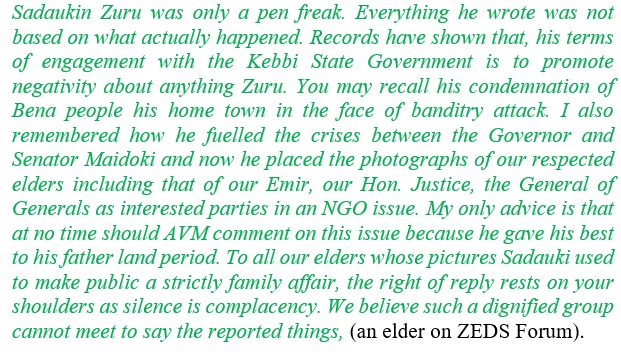
Their presence at a meeting does not, by itself, establish that they personally drafted or endorsed every expression in a subsequent press release. Yet, when the names and photographs of such eminent personalities are presented in connection with an institutional decision, the public may understandably associate them not only with the decision itself but also with the language used to communicate it. That is precisely why official communication demands care. Where the available evidence does not establish personal authorship or endorsement, responsibility should not be attributed by assumption.
The purpose of raising this concern is not to drag revered personalities into an unnecessary confrontation. It is to insist that public communication, particularly when issued in connection with an institutional decision, should reflect the restraint, fairness and wisdom expected of those who serve under the authority of respected institutions. The dignity of the Emirate and the reputations of its distinguished sons should not become collateral damage in an avoidable controversy.
Ultimately, this matter is bigger than AVM Sallau Ribah. It concerns the standard of fairness we are prepared to uphold today and the protection we may need tomorrow, when the person at the receiving end of similar treatment may be someone else. The question is not whether a leadership can be changed; it is whether such a change can be effected without unnecessarily diminishing those who have served.
In the next part, I will examine more closely the responsibility attached to the public communication of institutional decisions, the categorical claims made about the outgoing executive’s contributions, and the need for a standard of accountability that respects both the truth and the dignity of those concerned.