
THE POLITICS OF EXTINCTION: Why Zuru’s Indigenous Peoples Cling to Ethnic Identity
- Published on May 13, 2026
- By U.S. Machika
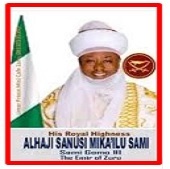
His Royal Highness
Alhaji Muhammadu Sanusi Munka’ilu, Sami Gomo III
The Paramount Chief and Chairman of Zuru Chiefs Council
There is a convenient habit in political commentary: to reduce every strong expression of indigenous consciousness to tribalism. It is an easy label, and it often spares analysts the burden of historical engagement. But in places like Zuru, such shortcuts do not merely misdiagnose reality; they distort it.
What is unfolding in Zuru is not the crude assertion of ethnic superiority. It is something far more uncomfortable to acknowledge: the defensive psychology of communities that believe they are managing the slow erosion of their own historical existence.
This is why the language of “tribalism” is analytically insufficient. It explains nothing. It only dismisses.
The autochthonous peoples of Zuru occupy a uniquely exposed position within Nigeria’s ethnolinguistic architecture. Unlike larger ethnic formations with expansive demographic reach across regions and borders, these communities are territorially concentrated, linguistically confined, and politically localised. Their survival does not extend beyond this space. If it weakens here, it weakens everywhere.
That is the first hard fact.
By contrast, Hausa and Fulani populations are embedded within far broader civilisational geographies that extend across Nigeria, the Sahel, and West and Central Africa. They possess demographic depth, migratory continuity, and institutional reinforcement far beyond any single locality. That structural asymmetry is not a moral argument; it is a demographic reality.
Yet it is precisely this asymmetry that produces political anxiety in smaller indigenous systems. Because history has repeatedly shown that when demographic weight meets political structure, cultural absorption often follows — sometimes gradually, sometimes decisively, but rarely neutrally.
This is not speculation. It is historical pattern recognition.
According to Ethnologue, the world’s most authoritative language database, Nigeria contains over 520 living languages, with more than 165 classified as endangered. Within this wider national reality lies Zuru — a concentrated cluster of minority languages existing under conditions of extreme linguistic pressure.
Ethnologue further confirms that at least one minority language in Sakaba Local Government Area has already become extinct. That single fact should end all romantic assumptions about cultural permanence. Languages do not disappear in theory. They disappear in real time, within real communities, under real political and social pressures.
Even the C’Lela language, central to the Lelna identity, has long been identified in linguistic scholarship as geographically concentrated and structurally vulnerable to external linguistic dominance. Colonial-era observations already hinted at the possibility of gradual decline under sustained assimilation pressure.
The uncomfortable truth is simple: languages do not die because they are weak. They die because their institutional ecosystems collapse.
And once that collapse begins, the process is rarely reversible.
- First, the language exits administration.
- Then education.
- Then religion.
- Then elite discourse.
- Then urban family life.
- Then, finally, memory itself.
At that point, extinction is no longer dramatic. It is procedural.
It is within this context that the absence of indigenous languages in formal religious practice becomes politically significant. In much of Northern Nigeria, Hausa emerged as the dominant medium of Islamic scholarship, preaching, jurisprudence, and religious instruction, reinforced over centuries by trade networks, emirate systems, and colonial administrative structures.
The consequence is visible today: indigenous languages in Zuru have been largely excluded from formal religious institutions.
Now, here is where interpretation divides.
To some, this is historical evolution. To others, it is structural linguistic consolidation — a long process in which smaller languages are steadily displaced from the most influential institutions of social meaning.
The difference between these interpretations is not academic. It is political.
Because:
- When a language loses religion, it loses intimacy.
- When it loses education, it loses continuity.
- When it loses administration, it loses authority.
- When it loses public legitimacy, it loses future generations.
And when all four disappear, what remains is cultural nostalgia without institutional protection.
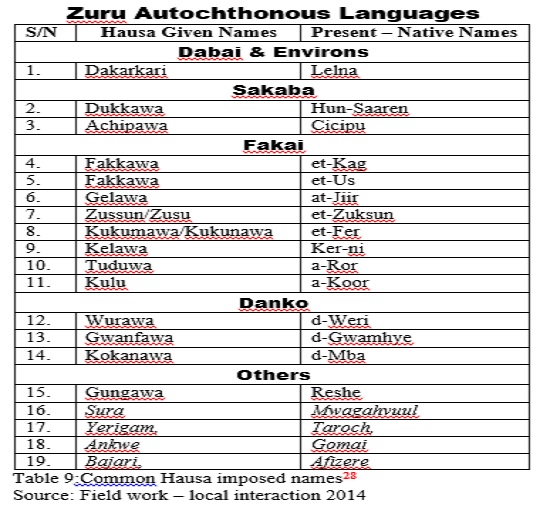
Within Zuru itself, this dynamic is further complicated by the existence of smaller indigenous groups whose identities were historically under-documented and, in some cases, absorbed into broader linguistic classifications such as Lelna. Only later did linguistic scholarship begin to recover their distinct identities.
That delayed recognition is not a harmless administrative detail. It reflects a deeper structural vulnerability: the ease with which small languages disappear from official visibility before they disappear from actual life.
And invisible communities rarely survive long-term political systems intact.
It is in this environment that ethnic consciousness emerges — not as ideological excess, but as survival calculation. Endangered communities do not debate identity in abstract philosophical terms. They experience it as a question of continuity or disappearance.
This is why Zuru’s indigenous groups often interpret political competition through a lens that outsiders frequently misread. What appears as electoral contestation is frequently experienced internally as a struggle over demographic security and historical continuity.
This is also why political alliances that extend beyond Zuru’s indigenous structure are often viewed with suspicion by some segments of the population. Not necessarily because of individual actors, but because of what such alliances symbolise: the possibility that local political outcomes may increasingly reflect external demographic strength rather than internal consensus.
Whether this perception is accurate in every instance is beside the point. Its political effect is real.
Because perception, in fragile systems, becomes political reality.
Historically, these communities have navigated successive waves of external political pressure — from pre-colonial state expansions to the Sokoto Caliphate, colonial administrative restructuring, and post-independence centralisation. Each phase reconfigured local power in ways that often reduced indigenous political autonomy.
It is therefore unsurprising that constitutional democracy was widely expected to correct, not replicate, these asymmetries.
Yet many within these communities argue that electoral politics is beginning to reproduce familiar patterns under new democratic language.
This is where the argument becomes uncomfortable, but unavoidable.
Because the question is no longer whether Zuru’s indigenous peoples are “politically sensitive.” The question is whether the political system adequately recognises the structural vulnerability of communities whose cultural survival is territorially confined.
At this point, a more difficult question emerges:
Is what is happening in Zuru simply multiethnic democracy in action, or is it the slow consolidation of political influence through demographic and external alignment in a way that reshapes indigenous control over ancestral space?
That question cannot be answered through slogans. It demands institutional transparency, demographic honesty, and constitutional seriousness.
But one point is already clear.
For many indigenous communities of Zuru, political outcomes are no longer interpreted as routine electoral results. They are interpreted as indicators of survival trajectory.
And when politics enters that psychological zone, democracy stops being experienced as competition and begins to resemble existential negotiation.
This is the real tension.
Not tribalism. Not sentimentality. Not irrational fear.
But the uneasy coexistence between democratic competition and communities that believe they are managing long-term cultural exposure to disappearance pressures.
Yet even here, a moral boundary must be firmly stated.
No political grievance — however historically grounded — justifies the transformation of democratic space into permanent ethnic antagonism. A system in which every election is read as a battle for survival is a system slowly losing its civic foundation.
The future stability of Zuru depends not on the denial of indigenous anxiety, but on the creation of a political order in which no community, regardless of size, influence, or history, feels structurally endangered within its own homeland.
Because when survival becomes politicised, politics ceases to be governance.
It becomes a struggle over historical continuity itself.
And that is where every society begins to approach its most delicate edge.