
THE MATHEMATICS OF SURVIVAL: Why Zuru Must Think, Speak, and Vote as One – II
- Published on May 11, 2026
- By U.S. Machika
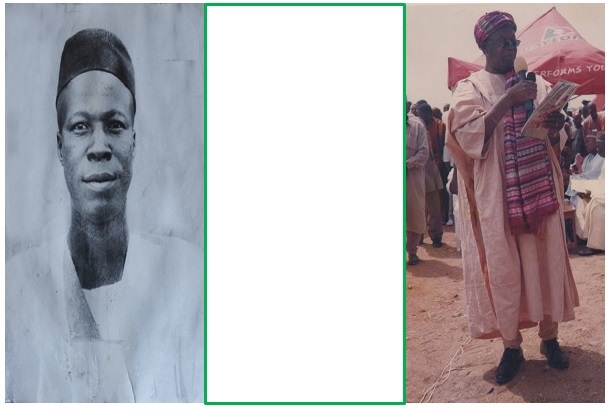
Representing a historical era of collective mobilisation and unified political direction in Zuruland, Bawa Makuku, Danladi Bamaiyi, and Nathaniel Zome symbolise the fading spirit of coordinated communal consciousness
Across Nigeria, major political actors negotiate influence through strategic alliances, regional solidarity, informal understandings, and long-term calculations of access to power. No serious political bloc approaches politics emotionally while others approach it strategically.
The real question therefore is this: why should Zuru alone enter modern power politics divided against itself while others consolidate theirs through coordination and consensus?
A difficult but necessary question now confronts Zuruland. Has a gradual psychological detachment emerged between many among us and the collective spirit of our motherland? Increasingly, narrower loyalties — religion, ethnicity, class, partisan camps, personal ambitions, and external political alignments — seem to compete against our shared destiny as a people.
Or have we unconsciously normalised fragmentation to such an extent that disunity now appears ordinary while unity itself is treated with suspicion? Perhaps even more profoundly, has this generation of Zuru drifted into political loneliness? Another painful but unavoidable question arises: has our society moved into a condition of political leaderlessness?
Not the absence of individuals of status or accomplishment — titled men, retired public servants, intellectuals, or influential personalities — but the absence of a coordinated moral voice capable of rising above factional interests to articulate and defend a shared Zuru vision at critical historical moments.
- Where, then, is that voice of moral coordination?
- Where are the elders whose age, sacrifice, and experience once positioned them as anchors of unity and direction by rising above divisions and rally the people towards common purpose?
- Where are the pressure groups that once defended communal interests with clarity and courage?
- Where is the spirit of collective mobilisation once associated with men like Bawa Makuku, Danladi Bamaiyi, and Nathaniel Zome?
- Where are the strategic pillars of society today?
- Where are the Generals whose discipline once reflected order and strategic thinking?
- Where are the Professors and intellectuals whose duty extends beyond classrooms into the preservation of societal consciousness?
- Where are the business leaders whose success ought to translate into communal influence and development?
- Where are the youths whose energy and creativity should now be shaping the political future of Zuruland?
These are uncomfortable questions — but necessary ones. Not born of hostility, but of reflection. Not of blame, but of awakening. Not of condemnation, but of responsibility.
Every generation eventually reaches a defining moment when silence becomes costly, indifference becomes dangerous, and unity becomes a necessity rather than a slogan. Or shall we remain spectators while others define our political future for us?
History shows that communities rarely lose relevance suddenly.
- They decline quietly — first through psychological disconnection from shared identity and purpose.
- Then through deepening distrust.
- Then through elite rivalries and competing loyalties.
- And finally through the inability to act collectively even when interests are obvious.
This is precisely where Zuru now stands. Advanced political societies understand something fundamental: internal rivalry may exist, but it must sometimes yield to collective survival. Political competition is healthy. Political self-destruction is not.
There are moments in history when communities must speak with one voice — not because unanimity is perfect, but because fragmentation can become fatal. Zuru is in such a moment. Political fragmentation is no longer abstract. It is costly.
- Every election is now not only a democratic exercise, but a measure of political relevance.
- Every divided mandate weakens bargaining power at state and federal levels.
- Every split vote reduces negotiating strength.
- Every internal fracture increases external manipulation.
That is why support for Senator Garba Musa Maidoki and Honourable Kabir Ibrahim Tukura should not be reduced to mere endorsement of individuals. It should be understood as part of a broader effort to preserve continuity, visibility, access, and the strategic consolidation of Zuru political relevance within Kebbi and national politics.
Yet many now speak from conditional positions: “If they secure the tickets, we will support them.” But a deeper question remains: what are we doing collectively to ensure that Zuru retains the capacity to influence who secures the tickets in the first place? The concern is therefore larger than any one candidate.
It is about ensuring that no external political structure arrogates to itself the exclusive authority to determine Zuru’s representation without meaningful internal consensus and coordination.
This requires a shift in political thinking.
Zuru must move away from:
- Voting emotionally;
- Voting impulsively;
- Voting individually;
- Voting against itself.
And move towards:
- Voting strategically;
- Voting collectively;
- Voting consciously;
- Voting for long-term leverage.
Both those at home and in the diaspora must understand a fundamental truth:
Political power is not secured on Election Day. It is built through psychological unity long before ballots are cast.
This essay is therefore not merely electoral. It is civilisational. It seeks to awaken patriotic consciousness among a people — especially the educated elite — who must rise above rivalry, factionalism, grievance, and short-term emotional politics. The cost of division is often invisible until history delivers its verdict.
Communities rarely collapse suddenly. They weaken gradually through suspicion, rivalry, manipulation, vanity, and the failure to distinguish personal disagreement from collective interest.
External actors rarely destroy political influence first. They merely complete what internal fragmentation has already weakened.
Zuru has repeatedly witnessed:
- How elite rivalries fracture unity;
- How external actors exploit divisions;
- How propaganda deepens confusion;
- How communities sometimes vote against their own long-term interest.
To break this cycle, unity must be properly understood. Unity is not dictatorship. Consensus is not intellectual submission. Strategic alignment is not the end of democracy. Rather, it is the strengthening of collective bargaining power while preserving internal diversity.
This is why the future demands:
- One Voice;
- One Direction;
- One Strategic Consciousness.
The future of Zuru political relevance is no longer about a Senate or House of Representative seats alone. It is about whether Zuru retains the psychological cohesion required to defend its place within the evolving structure of Nigerian politics. History is rarely kind to communities that fail to recognise their strategic moments.
Ultimately, this conversation is not only about voting. It is about survival, dignity, negotiating power, and the preservation of a political identity future generations will either inherit with pride or remember with regret. And when history finally judges this era, the question may not be about how many elites or leaders we had.
The real question may simply be this:
Did we possess enough unity to convert our numbers into power?